
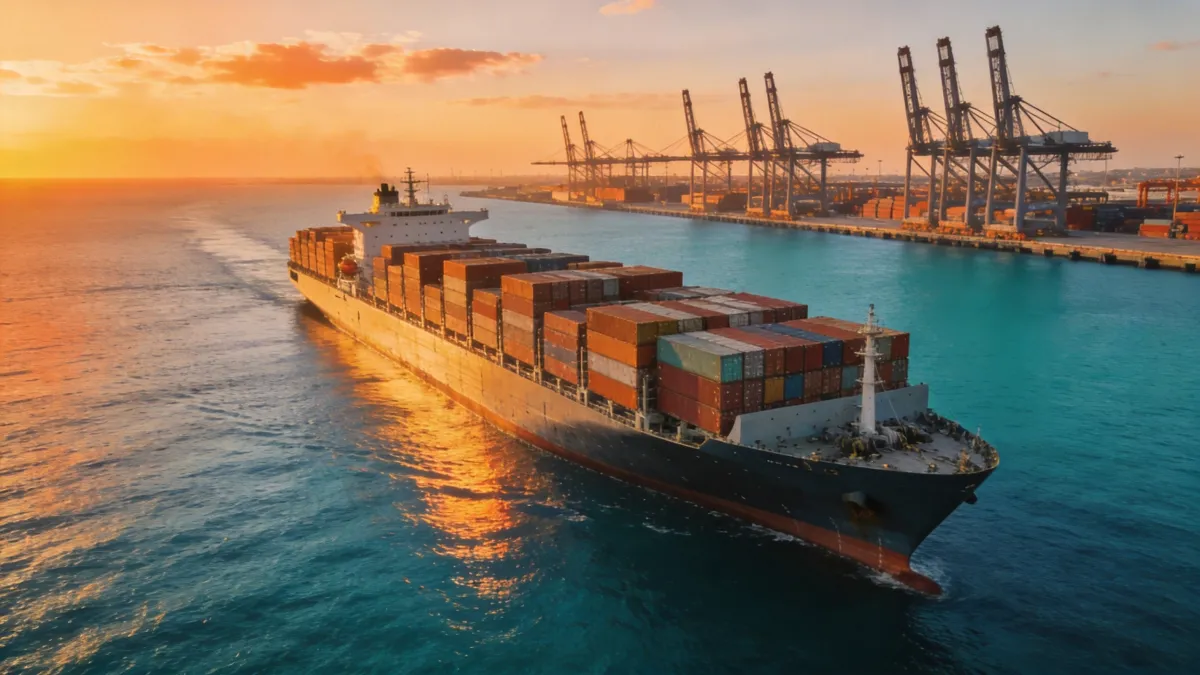
- The Drewry World Container Index stood at $4,434 per 40ft box on 1 October 2026 — around 154% higher than a year earlier.
- Suez container traffic is returning (week-39 transits were 68% higher year on year) and the share of global capacity diverting around the Cape has dropped to 4.6%.
- The main reason China–Gulf rates stay high is now the Strait of Hormuz, not the Red Sea: only about one commercial transit on 20 September versus a pre-crisis norm of roughly 85 a day.
- Maersk applies an extra $1,000 per container transiting the strait, plus an emergency freight charge of up to $3,800 for reefer, special and DG boxes.
- Practical rule: confirm the vessel name and sailing date in writing at least two weeks around Golden Week, and never price October on September's spot numbers.
Importers across the Gulf are asking the same question this week: if ships are returning to the Suez Canal week after week, why have container rates from China to Gulf ports not fallen at the same pace? The answer lies not in a single index but in two different waterways. One — the Red Sea and Suez — is visibly healing; the other — the Strait of Hormuz — remains effectively closed. This article sets out the official figures from late September and early October 2026, explains how both routes affect the cost of a box moving from Shanghai or Ningbo to Jebel Ali, Jeddah or Dammam, and gives a practical plan for traders in the final quarter.
What actually happened to freight rates in early October 2026?
The Drewry World Container Index fell for a second consecutive week to $4,434 per 40ft container on 1 October 2026, down 1% week on week. That decline, however, came almost entirely from the Asia–Europe trade, while Gulf-bound rates stayed firm.
On the Asia–Europe lane, Shanghai–Rotterdam dropped 2% to $3,399 per 40ft box and Shanghai–Genoa fell 3% to $3,702, after 12 consecutive weeks of decline on weak demand and the steady return of Suez routings. By contrast, Shanghai–New York rose 1% to $10,428, while Shanghai–Los Angeles held steady at $7,835.
On the Gulf lane specifically, the Shanghai Containerized Freight Index (SCFI) rate from Shanghai to Persian Gulf base ports came in at $6,489 per TEU on 30 September, down only 1.5% on the week. One week earlier (24 September), the Gulf lane had been the only major SCFI route to rise, gaining 5.4%. That gap between European and Gulf price action is the heart of the story.
The Suez recovery: what do the numbers really mean?
The good news is clear: Suez traffic is returning, but only partially. Drewry reported that container-ship transits through Suez in week 39 were 68% higher than in the same week a year earlier. Weekly transits rose from 41 ships in week 37 to 48 in week 38.
According to the Suez Canal Authority, container-ship net tonnage from January to August 2026 reached 72.1 million tonnes, up 54.2% from 46.7 million tonnes in the same period of 2025. The share of global capacity still diverting around the Cape of Good Hope has fallen to 4.6%, a two-year low.
Red Sea routing is currently assessed at only about 27% of its normalised level, meaning the recovery is real but incomplete. On the Asia–Europe lane this adds effective capacity without a single new hull, which is precisely why European rates fall quickly. For Gulf cargo, however, a separate bottleneck still dominates.
Why China–Gulf rates stay high: the Strait of Hormuz factor
The first reason the cost of reaching upper-Gulf ports remains elevated is that the Strait of Hormuz has not normalised. Data from the IMF trade monitor (IMF PortWatch) showed only about one commercial transit on the latest available day (around 20 September), against a pre-crisis average of roughly 85 vessels a day in both directions — about 1% of normal throughput.
The practical result is that carriers cannot serve the upper Gulf (Kuwait, Iraq, Qatar, Bahrain and the UAE) in the usual way. They instead discharge at Khor Fakkan or Salalah, move boxes overland by landbridge to Sharjah or the final port, and then connect through the intra-Gulf feeder network. Those extra steps add cost and time even if the Red Sea route fully recovers.
In its operational update No. 50, published on 29 September, Maersk officially stated that an emergency freight rate applies to cargo to or from Iraq, Kuwait, Saudi Arabia (Dammam and Jubail), Bahrain, Qatar, the UAE and Oman except Salalah: $1,800 per 20ft dry container, $3,000 per 40ft dry container and $3,800 for reefers, special equipment and dangerous goods. Any vessel transiting the strait also incurs an additional $1,000 per container, covering insurance premiums and crew-risk compensation.
This explains why an importer at Jebel Ali or Dammam does not benefit from falling Suez rates as much as an importer in Rotterdam: the cost of the final leg inside the Gulf is still set by Hormuz procedures, insurance and overland transport — not by the Suez Canal alone.
What does a container from China to the Gulf cost today?
Because the numbers move weekly, the table below shows the latest documented rates from late September 2026 by trade lane rather than by one broad index.
| Lane | Equipment | Rate (late September 2026) | Weekly move |
|---|---|---|---|
| Shanghai – Persian Gulf (SCFI) | 20ft TEU | $6,489 | –1.5% |
| Shanghai – Rotterdam (Drewry) | 40ft | $3,399 | –2% |
| Shanghai – Genoa (Drewry) | 40ft | $3,702 | –3% |
| Drewry WCI composite | 40ft | $4,434 | –1% |
| Gulf emergency freight (Maersk) | 40ft dry | +$3,000 | in effect |
| Hormuz transit fee (Maersk) | any box | +$1,000 | in effect |
Note that Gulf rates are often quoted per TEU in the Chinese index while European lanes are quoted per 40ft box, so the two figures cannot be compared directly without equalising the unit. The rates above are spot market rates including ocean freight and surcharges; they exclude destination port charges, inland haulage and customs clearance.
What about Golden Week and schedule reliability?
A second factor as important as price is schedule reliability. Xeneta data put global ocean schedule reliability at just 29% in August 2026, down around four percentage points in a single month, meaning fewer than one in three ships arrives on its scheduled day. Global port congestion continues to absorb more than 11% of containership capacity.
This overlaps with China's Golden Week holiday (1–7 October), when factories close and cargo deliveries to ports slow. Drewry expects rates to ease again during the break as volumes drop, but carriers have at the same time announced higher FAK rates for the second half of October after the holiday, and whether those increases hold is still uncertain. For timing a booking, see our note on the best time to ship containers from China, and to cut cost, review how to save money on shipping.
The practical lesson is that the holiday compresses the delivery schedule in both directions: cargo that does not reach the port before the break may slip a full week, and a pre-holiday quote does not guarantee a post-holiday booking price.
Practical steps: how to protect your margin in Q4 2026
If you plan to move goods from China to the Gulf in October or November 2026, follow these numbered steps in order:
- Obtain a quote for your exact destination port (Jebel Ali, Jeddah, Dammam, Hamad); never rely on a global index or last week's number.
- Ask the supplier or forwarder to confirm the vessel name, voyage number and sailing date in writing — at 29% reliability, a firm booking matters more than the cheapest quote.
- Book either well before Golden Week or with enough room after it; do not schedule production inside the holiday week if delivery is critical.
- If your port is in the upper Gulf, request a separate breakdown of surcharges (emergency freight, transit fee, insurance, landbridge) so no extra invoice arrives later.
- Compare standard ocean freight with express air freight for urgent orders, based on product margin and volumetric weight (see our guide to sea freight versus air freight to the Middle East).
- Consolidate into an FCL wherever possible, since LCL costs have risen on southern-China shipments; use consolidation near Ningbo or Shenzhen for small volumes.
- Prepare the full shipping documents checklist a week before sailing, because a missing certificate at clearance wipes out any rate saving.
A Keerki tip: when a single waterway sets your cost — Hormuz in this case — the real savings do not come from waiting for the broad index to fall. They come from verifying the exact route your box will take: a direct transit through the strait, or discharge at Khor Fakkan followed by an overland move. The difference in price and date between those two options can equal the entire margin of the deal, and it must be settled in writing before any deposit is paid.
Frequently Asked Questions
Did freight rates from China to the Gulf fall in October 2026?
Only marginally. The Shanghai-to-Persian-Gulf rate was $6,489 per TEU on 30 September, down 1.5%, after the same lane had risen 5.4% the previous week; it remains far above last year's levels.
Why haven't Gulf rates fallen even though ships are returning to Suez?
Because Suez solves the Red Sea problem, while the price of reaching the upper Gulf is set by the Strait of Hormuz. Traffic there is around 1% of normal, forcing discharge at alternative ports, overland transport, emergency freight and high insurance costs.
What are Maersk's extra charges on Gulf shipments?
They are $1,800 per 20ft dry box, $3,000 per 40ft dry box and $3,800 for reefers and special equipment, plus $1,000 per container transiting Hormuz, according to the official update of 29 September 2026.
Should I ship now or wait until after Golden Week?
For urgent cargo, secure the booking now because factories close during the holiday and schedule reliability is low. If delivery is not urgent, you can wait a couple of weeks after the break and compare rates, bearing in mind that carriers announced higher FAK rates for the second half of October.
Is the index figure the price I will actually pay?
No. Index figures are spot rates on specific base lanes and exclude destination port charges, inland transport, clearance and the extra emergency surcharges applied in the Gulf, so request a detailed quote to your final port.
How does Keerki help an importer in these conditions?
Keerki verifies the actual vessel route and applicable charges, negotiates booking and price, inspects goods before shipment, and follows discharge and overland movement inside the Gulf, so price and arrival date are fixed in writing before the deal starts.
Conclusion
The bottom line is that global shipping is no longer one market: the Asia–Europe lane falls quickly as Suez returns, while the China–Gulf lane remains under a different pressure point called the Strait of Hormuz, with emergency freight, insurance and overland costs that ultimately pass to traders and then consumers. A shipping decision in Q4 2026 should therefore be built on your vessel's actual route and a confirmed sailing date — not on a headline or a broad index.
Keerki Limited is a China-based sourcing and commercial representation company headquartered in Guangzhou, helping businesses in the Gulf and the Arab world import from China safely for over 10 years. If you have a shipment coming up and want the real route and charges confirmed before you commit, contact us through the service request page or WhatsApp at +86 133 9212 7362.


