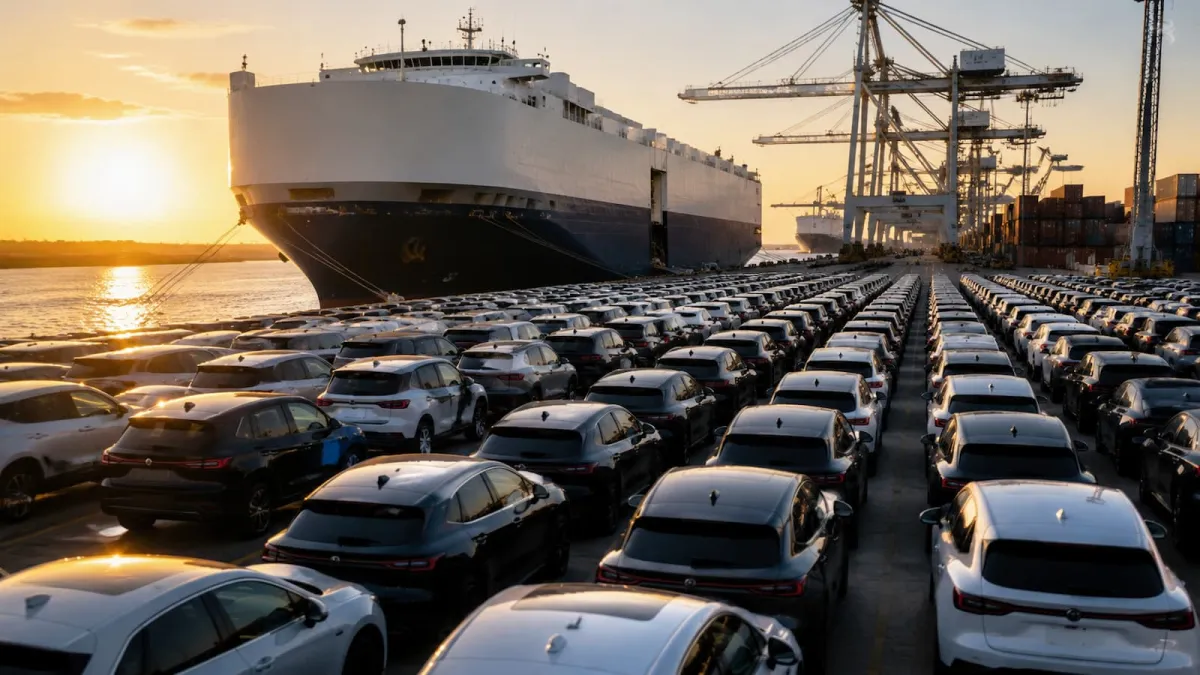
- China's new-energy vehicle exports reached 224,000 units in September 2026, up more than 100% year on year, according to CAAM and the China Passenger Car Association.
- Total Chinese vehicle exports passed 6 million units in January–August 2026, up over 50%, with electrified vehicles now making up more than half the mix.
- Chery alone exported 207,814 vehicles in September (+51%), setting a new monthly record for a Chinese brand.
- BYD exported 180,700 vehicles in September, and overseas revenue exceeded half of its total revenue in the first half.
- In Saudi Arabia, BYD benefited from the 0% import duty on electric vehicles and sold 3,200+ EVs in H1, holding about 45% of the EV market.
- Buyer takeaway: the bottleneck moved from "getting the car" to "clearing customs and certification"; sort SABER/SASO before you sort price.
In the first days of October 2026, China released the numbers for what the industry calls its "Golden September," and one figure caught the attention of importers across the Gulf and the wider Middle East: new-energy vehicle exports doubled in a single month. That surge is changing the kind of risk a trader manages when importing cars and spare parts from China. The question is no longer "can the factory spare volume for export?" but "can the shipment clear the certificates and customs at my port?". This article lays out the documented figures for September and Q3 2026, explains what they mean for importers of electric and hybrid vehicles and auto parts in Saudi Arabia and the rest of the Gulf, and gives a practical checklist before the peak final quarter.
What do China's September 2026 auto export numbers say?
The headline came from data by the China Association of Automobile Manufacturers (CAAM) and the China Passenger Car Association (CPCA): exports of new-energy vehicles — battery electric and plug-in hybrid — reached 224,000 units in September 2026, more than double the level of September 2025, an increase above 100%. In August alone, China exported 526,000 new-energy vehicles, up 134.6% year on year, while electrified cars accounted for more than 60% of new-car sales at home.
Across the whole industry, Chinese vehicle exports passed 6 million units during the first eight months of 2026, up more than 50% on the same period of 2025, and new-energy vehicles made up more than half of those exports for a third consecutive month. This is the first time an electric drivetrain, rather than a petrol engine, has become the single largest component of China's vehicle exports.
The direct commercial meaning is that the supply of Chinese export vehicles is no longer the constraint. For years an overseas distributor worried about whether a factory could allocate surplus production to foreign markets; today the constraint sits downstream of the factory — certification, customs, capacity on roll-on/roll-off (RoRo) car carriers, and after-sales service.
The brand numbers: Chery and BYD lead the export wave
Company figures show the export growth is not a vague industry trend but is driven by specific brands with documented numbers. The Chery Group sold 292,300 vehicles in September, of which it exported 207,814 units, up 51% year on year. It was only the second time the brand cleared 200,000 exports in a single month, setting a fresh monthly record for a Chinese brand. Its cumulative exports over the first nine months reached 1,551,178 vehicles, up 65.6%, while exports of its new-energy models rose 174% in September.
BYD, meanwhile, delivered 456,713 passenger vehicles worldwide in September (183,570 plug-in hybrids and 273,143 battery-electric), of which 180,700 were exported during the month. First-half data show overseas revenue exceeded half of its total revenue: it exported 792,000 vehicles, up 67.8%, and generated 181.27 billion yuan overseas at a 21.7% overseas gross margin — far above its domestic margin.
That margin gap explains why exports became a strategic priority: profits from foreign markets offset the brutal domestic price war and in turn fund expanded export and shipping capacity. For an importer it means negotiations with these brands will be more professional and stable on the supply side, but matched by clearer requirements on volumes, commitment and certification.
What does it mean for the Saudi and Gulf car market?
The Gulf market, and Saudi Arabia in particular, is among the biggest beneficiaries. First-half 2026 data show BYD sold more than 3,200 electric vehicles in Saudi Arabia, holding about 45% of the EV market and moving ahead of its rivals. Its sales in the Kingdom rose 277% year on year, while the overall share of Chinese vehicles in the Saudi market passed 14%, with expectations it could reach 18%.
Behind that growth is a direct policy and regulatory driver: the 0% import duty on electric vehicles versus 5% on petrol cars, free EV registration for the first three years, and charging infrastructure that expanded past 500 public stations. That duty advantage makes a Chinese EV cheaper on landed cost even before list-price comparison, which is an added reason for its rapid advance.
The market also benefits from Chinese technology tuned to the climate: BYD's Blade Battery is known for high heat resistance, an important factor in Gulf summers. As the market expands, newer Chinese brands such as SOUEAST opened a flagship Riyadh showroom in October 2026, with a spare-parts centre and a pledge of 48-hour nationwide delivery — a sign the market is shifting from simply importing cars to building a local service ecosystem.
The shift toward local manufacturing: what it means for distributors
A parallel development of equal importance is that the model of "build in China and only ship by sea" is peaking. The data indicate Chinese brands now operate more than 130 plants outside China, with local investment accelerating in Europe, Southeast Asia and Africa. BYD is building plants in Thailand and Hungary, Chery has projects in Spain and South Africa, and regional assembly lines have started with the aim of raising local content.
For a Middle East distributor the shift carries two opposing messages. The first is positive: supply will become more stable and diverse, with the likelihood of pre-positioned stock in regional hubs rather than build-to-order waiting, which pushes delivery times down. The second calls for caution: markets that require assembly or local content will reshape import channels, and an importer should track a brand's model — direct export, regional assembly, or local partnership — before building a long-term stocking plan.
At present, direct import from China remains the most price-efficient route for most Gulf markets, especially with the EV duty exemption, but large-volume decisions should account for the brand's localization direction over the next two years.
Comparison table: key September 2026 export figures
To make the multiple figures easier to read, the table below summarises the documented indicators for September and the first nine months of 2026.
| Indicator | Value (2026) | Year-on-year | Source |
|---|---|---|---|
| New-energy exports – September | 224,000 units | +over 100% | CAAM / CPCA |
| Total vehicle exports – Jan–Aug | over 6 million | +over 50% | CAAM |
| Chery exports – September | 207,814 units | +51% | Company |
| Chery cumulative exports – 9 months | 1,551,178 units | +65.6% | Company |
| BYD exports – September | 180,700 units | — | Company |
| BYD overseas revenue – H1 | 181.27bn yuan | 21.7% margin | Disclosure |
| BYD EV sales in Saudi – H1 | 3,200+ units | +277% | Market data |
| Saudi import duty on EVs | 0% | vs 5% petrol | Customs policy |
Note the different statistical windows across sources: some figures cover all of September, others the first half or August, and these values should not be merged into one number. Market-share estimates also vary by measurement body (14% versus 18%) depending on the data window, so they are presented as reported.
Practical steps: how to benefit from the export wave in Q4
If you plan to import electric or hybrid vehicles, or volumes of spare parts, from China in the final quarter of 2026, follow these numbered steps in order:
- Define the exact customs classification for your vehicle or parts first, and confirm EV-duty eligibility in your country before pricing, because 0% versus 5% changes the whole equation.
- Start the SABER/SASO certification process before locking the booking, since conformity lead time is now the real bottleneck rather than car availability.
- Book capacity on RoRo car carriers or containers early, because the export surge is tightening specialised shipping capacity in the peak season.
- Ask the factory to confirm Gulf-market specifications (heat, air conditioning, system language, warranty) in writing; do not accept a version built for another market.
- Build the after-sales plan before the first shipment: core spare-parts stock, an approved warranty and a service centre, because new brands now compete on parts speed, not only on price.
- Compare direct import against buying from a regional assembly hub for large volumes, based on the brand's localization direction and your country's requirements.
- Use a team that checks conformity and quality before shipping and follows clearance, so abundant supply does not turn into cars stuck at port.
For the full import procedure, see our guide on importing from China to Saudi Arabia in 2026; for parts rules, read sourcing automotive spare parts safely; and for production locations, review the top automotive spare-parts manufacturing hubs in China.
A Keerki tip: when the car is abundant, your real value as an importer shifts to compliance management and after-sales, not to securing volume. Secure the conformity certificate and core spare-parts stock before the first shipment arrives; the difference between a car sold immediately and one sitting in port or waiting a month for a replacement part can equal the profit of the whole season.
Frequently asked questions
Did Chinese EV exports really double in September 2026?
Yes. New-energy vehicle exports reached 224,000 units in September, up more than 100% year on year, according to CAAM and the China Passenger Car Association. In August alone, China exported 526,000 new-energy vehicles, up 134.6%.
Which Chinese brands currently lead exports?
Chery leads with 207,814 exports in September (a monthly record) and 1.55 million over the first nine months, followed by BYD with 180,700 exports in September, whose overseas revenue exceeded half of its total revenue.
Why are Chinese EVs advancing so fast in Saudi Arabia?
Because of the 0% import duty on EVs versus 5% on petrol cars, free registration for the first three years, expanding charging stations, and batteries adapted to high heat. BYD alone sold more than 3,200 EVs in the first half.
Is the availability of Chinese cars now guaranteed?
Supply is no longer the main constraint, but risk has moved to certification, customs, capacity on car carriers and after-sales. That is why SABER/SASO procedures and shipping capacity should be arranged early.
Will local-manufacturing trends affect my imports from China?
In the short term, direct import from China remains the most price-efficient route for most Gulf markets. In the medium term, brands operate more than 130 plants outside China and some markets may require local assembly, so the brand's model should be monitored before long-term stocking.
How can Keerki help me import vehicles from China?
Keerki verifies customs classification and duty eligibility, manages SABER/SASO certificates, checks vehicle conformity and warranty before shipping, books transport and follows clearance, and helps build spare-parts stock and an after-sales plan, so the shipment arrives ready to sell rather than stuck in port.
Conclusion
The September 2026 figures confirm that China has turned vehicle exports into a massive, electric-led machine, with monthly records from brands such as Chery and BYD and higher overseas profits funding further expansion. For Middle East importers this means abundant supply, but it also moves the point of competition and risk to customs compliance, conformity and after-sales service. Those who arrange certificates, shipping and a parts plan early will capture the wave; those still managing imports with a "find the rare car" mindset will find the car is available but stuck.
Keerki Limited is a commercial representation and sourcing company based in Guangzhou, China, helping companies and traders across the Gulf and the Arab world import vehicles and spare parts from China safely for more than 10 years. If you are planning an upcoming shipment and want to verify the customs classification, certificates and real cost before committing, contact us through the service request page or WhatsApp +86 133 9212 7362.