- China exported $88.7 billion of auto parts in January–October 2026, up 12%, but October alone reached $9.2 billion, up 32% year on year — the acceleration sits in October alone, not in the average.
- Maersk's emergency freight rate published on 18 November 2026 adds $3,000 to a 40ft dry container bound for Gulf ports, plus $1,000 per container on vessels transiting the Strait of Hormuz.
- DP World's Gulf chief executive put the all-in China–Dubai container cost at $10,000–12,000, against roughly $2,000 before navigation was disrupted.
- Demand follows the Chinese car parc: brakes, filters, suspension and lighting move faster than heavy mechanical parts.
- The practical response is to split urgent parts into air freight, keep heavy parts on the water, and price the order on November 2026 charges rather than Q3 rates.
China shipped $9.2 billion of auto parts in October 2026, 32% more than a year earlier, according to the customs export table published on 10 November 2026. For a Gulf importer the timing is awkward: demand for Chinese-brand parts is rising while the cost of a container into the region has multiplied.
This guide separates real demand from headline growth, prices a parts container on November 2026 charges, and sets out how to build a Q1 2027 order around both.
What Do the October 2026 Numbers Actually Show?
China's goods exports reached $3.785 trillion in January–October 2026, up 23%, and October alone came in at $412.3 billion, up 35%, according to the customs export table of 10 November 2026, as summarised by analyst Cui Dongshu on 20 November 2026.
Inside that total, auto parts were worth $88.7 billion over ten months, up 12%, while complete vehicles reached $169.6 billion, up 52%. The China Association of Automobile Manufacturers reported 1.066 million vehicles exported in October 2026, up 60.2%, including 606,000 electric vehicles, up 140%.
The gap is the story: the Chinese car parc abroad grows at 52% a year while parts exports grow at 12%, so part of that aftermarket demand has not been ordered yet, or is served through other channels.
Why Did October Jump 32% When Ten Months Averaged 12%?
No official breakdown explains the October figure, but three readings fit. The first is timing: importers pushed orders ahead of new freight charges effective 16 November 2026, so some November cargo sailed in October.
The second is structural. Every thousand Chinese cars sold abroad create recurring demand for filters, brakes and suspension parts within 12 to 24 months. With 9.271 million vehicles exported in ten months, that demand stops behaving like a seasonal spike.
The third is competitive. Cui Dongshu wrote on 20 November 2026 that parts exporters are under pressure and must follow Chinese manufacturers abroad instead of relying on European and American aftermarket channels. Growth sits in parts that fit Chinese badges.
Which Parts Are Actually Moving in Gulf Warehouses?
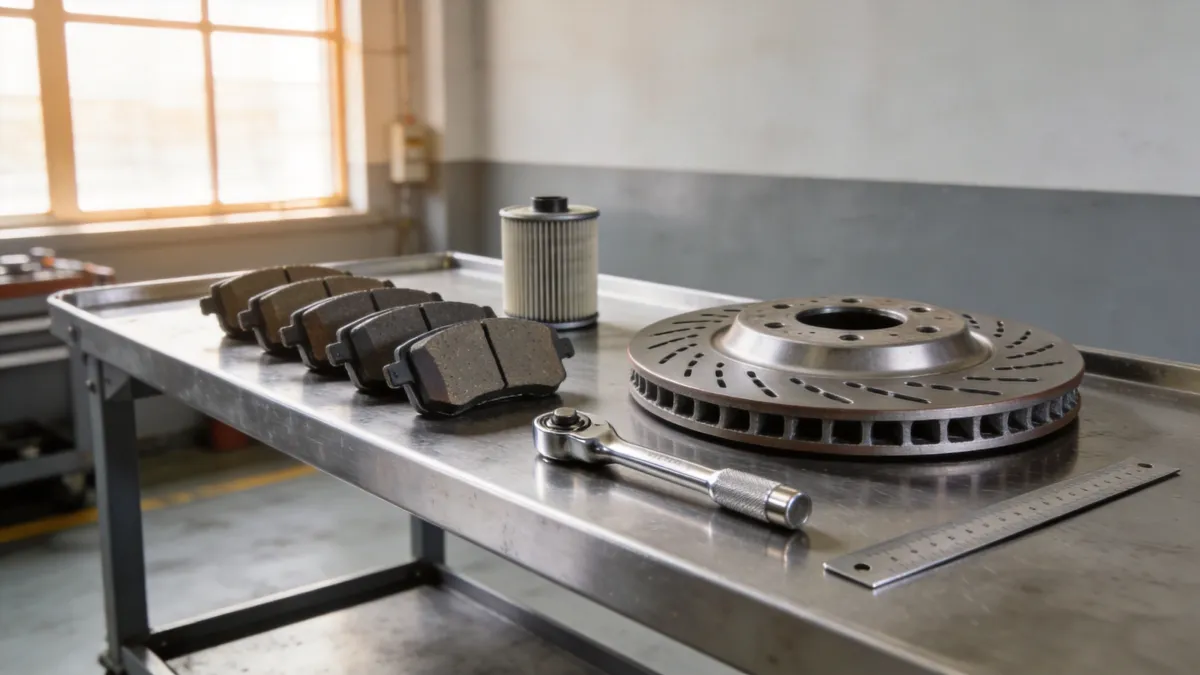
The fastest-moving categories are the consumables a new Chinese car needs in its first three years, not heavy mechanical assemblies. The table below maps demand drivers to the checks that matter before you place a purchase order.
| Part category | Demand driver in the Gulf | Price sensitivity | What to verify first |
|---|---|---|---|
| Brakes: pads and discs | Chinese cars in daily use on hot, abrasive roads | Medium | Compliance with the brake standards listed in Saudi spare-parts annexes |
| Filters: oil, air, fuel | Scheduled service every 5,000–10,000 km | Low | Original part number and catalogue coverage of models actually sold locally |
| Suspension and steering | Uneven roads and high payloads | High | Actual carton weight and freight cost per kilogram |
| Lighting | Periodic vehicle inspection requirements | Medium | Approved lighting standards in each Gulf market |
| Batteries and electrics | Heat shortens battery life | Medium | Dangerous-goods classification and carrier acceptance rules |
| Body panels and glass | Accident repair and resale preparation | High | Glass standards and per-country import formalities |
On 19 November 2026, Gasgoo reported that MANN-FILTER had expanded its range for Chinese-brand cars to 242 applications covering 133 models from more than 20 manufacturers, targeting coverage above 82% by the end of 2026 — a clear signal about where consumable volume sits.
China Daily reported on 9 November 2026 that after-sales service is the weak point of China's overseas expansion, naming spare-parts supply, maintenance and technician training, with Geely building regional warehouses. Replacement tyres account for about 75% of global tyre demand, the same report said. The part on the shelf when the car is on the lift keeps the margin.
What Does It Cost to Land a Container of Parts in the Gulf Now?
Landing costs rose by thousands of dollars per container, and the November 2026 figures are public. On 4 November 2026 Maersk announced a peak-season surcharge from China to the UAE, Bahrain, Kuwait, Qatar and Dammam of $1,000 per 20ft and $2,000 per 40ft or 45ft, effective 16 November 2026.
Its operational update 55 of 18 November 2026 then set an emergency freight rate of $1,800 per 20ft dry, $3,000 per 40ft dry and $3,800 per reefer, special or dangerous-goods container, plus $1,000 per container on vessels transiting the Strait of Hormuz. Cargo held in storage in transit beyond 14 days attracts $25 per TEU per day.
| Charge | Published amount | Scope | Source and date |
|---|---|---|---|
| Peak-season surcharge | $1,000 per 20ft / $2,000 per 40ft and 45ft | China to UAE, Bahrain, Kuwait, Qatar, Dammam | Maersk, 4 November 2026 |
| Emergency freight rate | $1,800 / $3,000 / $3,800 | 20ft dry / 40ft dry / reefer, special and DG | Maersk, 18 November 2026 |
| Hormuz transit fee | $1,000 per container | Cargo on vessels transiting the strait | Maersk, 18 November 2026 |
| Storage in transit | $25 per TEU per day | After 14 days of storage | Maersk, 18 November 2026 |
| Total published charges, 40ft dry | $6,000 | If the seasonal, emergency and transit charges all apply | Sum of the figures above |
| Estimated all-in China–Dubai cost | $10,000–12,000 | Includes trucking, congestion and fuel effects | DP World Gulf chief executive, 18 November 2026 |
For context, the Shanghai Containerized Freight Index stood at 3,572.33 on 13 November 2026, down 1.68% week on week, according to the Shanghai Shipping Exchange. The headline index is easing while Gulf costs rise because the route itself is the problem: the China–Middle East index reached 392 in September 2026, up 250% since January.
How Has the Gulf Route Changed Since October 2026?
Routing is no longer one ocean leg to one port, but a chain of sea and land moves to be priced before booking. Hapag-Lloyd's week 44 Middle East update, issued on 30 October 2026, reported Jebel Ali scheduling only ad hoc vessel calls, Salalah yard density at 84% with berthing delays of up to 36 hours, Sohar delays of two to three days, and delays of up to two days at Bahrain's ports.
In the UAE, boxes booked to Khor Fakkan are routed through Sajaa customs zone and some final destinations shifted to Jebel Ali. Saudi cargo for Dammam and Jubail moves overland from Jeddah at extra trucking cost, and some reefer and dangerous-goods bookings to those ports were suspended.
Parts cargo is mostly dry but heavy and mid-value, so a two-week delay freezes working capital and empties a shelf. Empty returns are also restricted to designated depots, raising detention exposure.
Practical Steps to Build a Q1 2027 Parts Order
The sequence below reduces the chance of an empty shelf or an unbudgeted freight invoice.
- Collect original part numbers against the VIN for every model you sell, instead of describing the part by name, because names differ between factories.
- Split the order into three tiers: parts that stop a vehicle, scheduled-service parts, and slow-moving heavy parts.
- Ask for carton weight and volume, because light bulky parts are charged on volumetric weight.
- Verify conformity before production: regulated parts in Saudi Arabia follow a conformity route through the SABER platform and may require a type certificate where the supplier is not an original manufacturer; confirm the scope with your conformity body.
- Price the order on November 2026 charges, not Q3 rates, and add a buffer for port delay and detention.
- Air-freight the urgent lines only where the cost per kilogram is smaller than the cost of a vehicle off the road.
- Fix production dates before 5 February 2027, because China's official Spring Festival holiday runs from 5 to 13 February 2027 under the State Council notice published on 5 November 2026, and factories ramp back up gradually afterwards.
Keerki tip: on heavy parts, the 20ft versus 40ft decision is about weight, not price. Ask the factory for net weight per container before booking, because a box that hits the weight limit while half empty costs more than two smaller ones. On light bulky parts you pay volumetric weight.
Frequently Asked Questions
Did Chinese parts prices themselves rise in 2026?
Published data does not show a sharp rise in factory prices; export value grew mainly on volumes and a shift towards parts for newer models. What rose clearly is delivery cost: freight, transit and storage charges announced in November 2026.
How long does a container take from China to Jeddah or Dammam?
There is no single transit time: cargo for Dammam and Jubail moves overland from Jeddah, and berthing delays of several days are reported at several ports. Plan one month to seven weeks from loading by sea, plus a week where inland trucking is long.
Can parts be shipped by air instead of sea?
Yes for urgent, light, high-value lines such as sensors and electronic modules. It rarely works for brake pads, discs or shock absorbers, where weight pushes cost above the part's value. Working rule: if weight in kilograms approaches price in dollars, model air freight.
Do all parts need conformity certification in Saudi Arabia?
No. The scope depends on the part, its risk level and whether it comes from an original manufacturer or a third-party supplier. Regulated parts are listed in the annexes of the Saudi spare-parts regulation; some need a type certificate, others accept a supplier declaration. Check with your conformity body before production.
How do I confirm a part fits my vehicle before ordering?
The safest method is matching the original part number to the VIN, then asking the factory for a photo and dimensions of the part. Many errors happen because two models share a name but differ in engine or brake specification.
Should I order before or after the February 2027 holiday?
Fast-moving parts should be ordered before the holiday, because factories cut output before 5 February 2027 and return gradually after 13 February. Slow-moving lines can wait until March 2027, while freight rates are watched.
Conclusion
The October 2026 figures confirm that Chinese parts exports are accelerating and that real demand sits in consumables for the Chinese-brand car parc, while the container cost into the Gulf has multiplied and the route has become less predictable.
Buying at third-quarter 2026 prices and planning on 2025 transit times erodes the margin before the part is sold. Importers who tier orders, price the published charges and lock production before 5 February 2027 reach the shelf in time.
Keerki Limited is a China-based sourcing and commercial representation company headquartered in Guangzhou, helping businesses in the Gulf and the Arab world import from China safely for over 10 years, with auto parts as its main specialisation. Keerki's team can help verify factories, match part numbers, consolidate cargo from several factories into one container and reduce the risk of an empty shelf in peak season.
To request a service or discuss your next parts order, use the form at https://keerki.com/request/ or message WhatsApp +86 133 9212 7362. You can also search the auto-parts supplier directory before you finalise the order list.
For exhibition dates and sourcing trips in China, see the China exhibitions calendar, and to compare vetted factories see recommended factories.
Sources: China Customs, 10 November 2026; Maersk, 4 and 18 November 2026; DP World, 18 November 2026; Shanghai Shipping Exchange, 13 November 2026; China Daily, 9 November 2026; Gasgoo, 19 November 2026.