- China now has 17 companies in the 2026 Automotive News Global Top 100 Suppliers list — surpassing the US and Germany for the first time in history.
- The Chinese entrants span three categories: EV batteries & powertrains, automotive chips, and interiors & smart cabins.
- This shift translates directly into 20–40% lower prices for Gulf importers sourcing aftermarket auto parts from China.
- Bosch, the world's largest auto supplier, now earns over €15 billion annually from China — more than 25% of its global auto revenue.
- Chinese-led international EV standards are now recognized under IEC, ISO, and UN R155 frameworks — accelerating market access globally.
On October 5, 2026, Automotive News — the American publication that has ranked global auto suppliers for over a century — released its annual Top 100 list. The headline: 17 Chinese companies made the cut, overtaking the United States and Germany for the first time. In 2013, there was just one. For Gulf importers who source spare parts from China, this is not just a ranking change — it fundamentally reshapes the supply landscape in terms of pricing, quality, and availability.
What Does the Global Top 100 Ranking Actually Measure?
Published by Automotive News, one of the most authoritative voices in the global automotive industry, the list ranks suppliers worldwide based on their automotive-parts revenue. It serves as the benchmark for assessing which companies hold real manufacturing influence in the sector, covering suppliers that serve brands like Toyota, Ford, BMW, BYD, and Volkswagen.
For importers, having a Chinese supplier on this list means that company has proven its ability to produce at world-class standards — this is the fundamental difference between an unverified vendor and an internationally recognized manufacturer. The jump from 1 Chinese company in 2013 to 17 in 2026 represents more than incremental growth. It signals a structural shift: Chinese manufacturers have moved from low-cost commodity suppliers to technology-driven competitors capable of matching — and in some cases exceeding — European and Japanese standards.
Who Are the Chinese Companies That Made the List?
According to analysis by People's Daily (Renmin Ribao), the 17 Chinese entrants fall into three distinct groups:
| Category | Key Companies | Core Products | Relevance for Gulf Buyers |
|---|---|---|---|
| Batteries & EV powertrains | CATL (宁德时代), Gotion (国轩高科) | Lithium battery packs, electric motors, battery management systems | Critical as EV adoption accelerates across Saudi Arabia and the UAE |
| Automotive chips & electronics | Joyson Electronics (均胜电子) | Control chips, ADAS modules, infotainment systems | Essential for maintaining modern vehicles with advanced electronics |
| Interiors & smart cabins | Yanfeng (延锋) | Instrument panels, seating systems, cockpit electronics | High-quality replacements at competitive prices for both ICE and EV |
Meanwhile, Bosch — the German giant and world's number-one auto supplier — reported €15 billion in China revenue last fiscal year, representing over 25% of its global automotive business. As Bosch's then-CEO Stefan Hartung stated: "China is no longer just a manufacturing base — it is a critical innovation center for us. In areas like assisted driving and software, our China team plays an increasingly central role."
Similarly, Eberspächer — the 160-year-old German supplier — now has approximately 100 engineers in China and plans to transfer China-developed technologies "back" to the German market. This reversal of the traditional technology flow underscores a new reality: automotive innovation is no longer the exclusive domain of Europe and Japan.
What Chinese-Made Auto Parts Are Now Available in Gulf Markets?
According to data from Accio global trade analytics, the GCC auto parts market is projected to grow at a CAGR of 7.4% through 2028, with Dubai serving as the region's primary distribution hub. Chinese suppliers are increasingly dominant across multiple categories, driven by the growing presence of Chinese vehicle brands on Gulf roads:
- EV-specific parts: Replacement batteries for BYD, Geely, and Chery models; electric motors; thermal management systems — available at 30–50% below European alternatives.
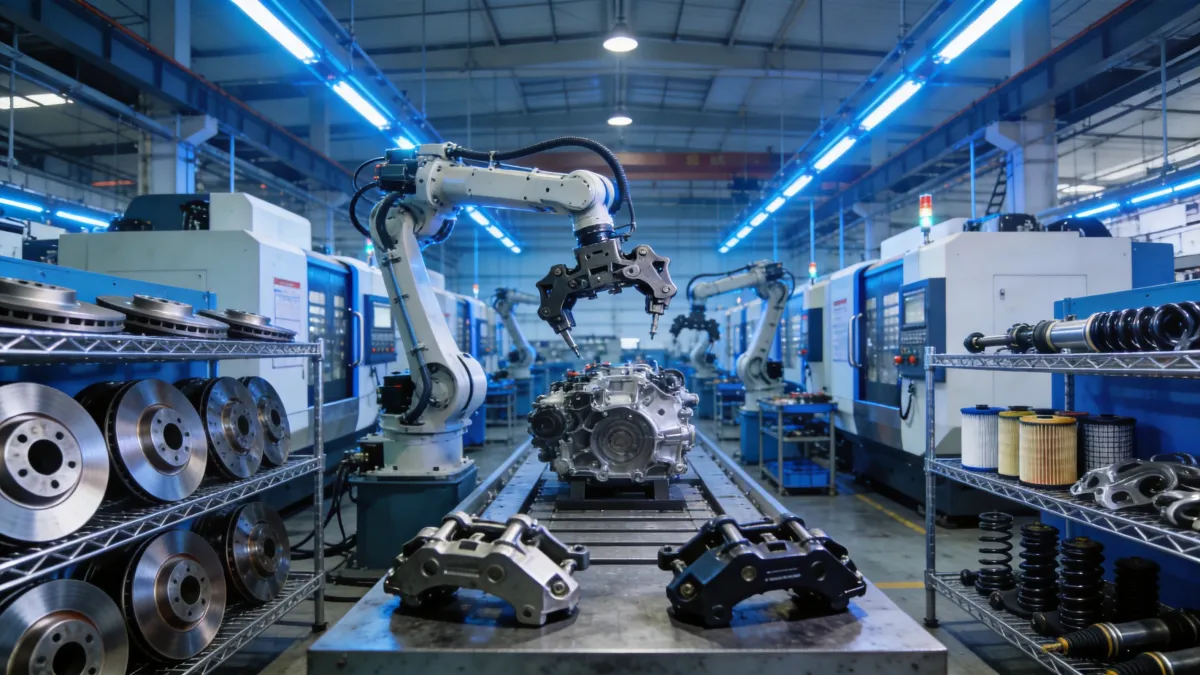
- Braking & suspension: Ceramic brake pads starting at $2.40/set, brake discs, control arms, and shock absorbers — all meeting OE-grade specifications.
- Filtration & exhaust: Oil and air filters from $0.98/unit; catalytic converters compliant with Euro 1 through Euro 6.
- Lighting systems: LED headlamps, tail lights, and Canbus-compatible signal modules from Chinese manufacturers in Guangdong province, which houses over 60% of China's auto lamp factories.
- Engine components: Valve covers, gaskets, and upper/lower engine assemblies for both Chinese and Japanese/Korean vehicle platforms.
- Body parts: Front and rear bumpers, grilles, and side mirrors for BYD, Tesla, and Japanese/Korean models — at 60–75% savings versus OEM pricing.
How Does This Shift Affect Pricing for Gulf Importers?
The direct impact: 20–40% savings on average compared to European or Japanese OEM parts — with quality rapidly converging toward OE standards. This price advantage stems from several factors: economies of scale in massive Chinese factories, relatively lower labor costs, and deep vertical integration of supply chains within China.
| Part Type | EU/Japan Price (USD) | China Price (USD) | Savings | Quality Standard |
|---|---|---|---|---|
| Ceramic brake pad set | 15–25 | 2.40–5 | 70–80% | OE-grade |
| Front control arm (Tesla Model 3/Y) | 80–120 | 38–45 | 50–60% | Aftermarket OEM |
| LED headlamp assembly | 150–300 | 25–60 | 60–80% | DOT/SAE compliant |
| Engine oil filter | 8–15 | 0.98–3 | 70–85% | IATF 16949 |
| Front bumper (BYD Song Plus) | 200–350 | 45–80 | 60–75% | OEM replacement |
How Can Gulf Buyers Verify Chinese Supplier Quality?
Low prices alone don't guarantee value. Here is a step-by-step verification process that Keerki's team applies daily in Guangzhou:
- Check certifications: Require IATF 16949 (the international automotive quality management standard) and at minimum ISO 9001. This single certification confirms the production line actually serves global automotive brands.
- Request samples: Order product samples before committing to bulk purchases. Test them in certified labs when possible — verify dimensions, materials, and functional performance.
- Factory audit: Visit the factory in person or engage a trusted commercial representative in China to inspect on your behalf — checking production capacity, quality control processes, and actual export volumes.
- Review export track record: Verify whether the supplier already exports to GCC countries or Europe (which implies compliance with strict standards like SASO, CE, and DOT).
- Pre-shipment inspection: Hire an independent quality inspection service (SGS, Bureau Veritas, TÜV) before goods are loaded — typically costing under 0.5% of shipment value.
- Transaction history: On platforms like Alibaba or Made-in-China, review buyer ratings, transaction volumes, and reorder rates — the latter being a stronger indicator than ratings alone.
Keerki's tip: From our daily experience working with Chinese factories from our headquarters in Guangzhou, we advise Gulf importers to work exclusively with IATF 16949-certified manufacturers. Additionally, always request an SGS or Bureau Veritas pre-shipment inspection report — the cost is typically under 0.5% of the shipment value, but it protects your entire investment. And remember: if a price is more than 90% below market rate, there's likely a quality issue or the product is counterfeit.
Are Chinese EV Parts Ready for the Gulf Market?
Yes, and increasingly so. According to China's Ministry of Industry and Information Technology (MIIT), China has led the development of over 60 international standards for new-energy vehicles — covering battery safety, autonomous driving systems, electromagnetic compatibility, and charging infrastructure.
These China-led standards align with IEC, ISO, and UN WP.29 frameworks, including UN Regulation No. 155 (cybersecurity management). This means Chinese EV parts are gaining faster market access in regions that adopt these frameworks — including GCC countries that reference SASO and SABER standards. Notably, conformity assessment timelines are shortened by 3–6 months and certification costs reduced by approximately 18% due to harmonized test protocols.
Furthermore, five Chinese ministries launched a joint enforcement campaign in 2026 to regulate used lithium-ion battery exports, strengthening traceability and environmental compliance — aligning with sustainability goals across GCC Vision 2030 frameworks and the UAE's carbon neutrality initiatives.
Frequently Asked Questions
Are Chinese auto parts lower quality than European or Japanese ones?
Not necessarily. The 17 Chinese companies now in the Global Top 100 produce at standards matching original equipment (OE). Companies like Bosch and Valeo are investing billions of euros in Chinese innovation centers. The quality gap is closing rapidly, especially in brake pads, filters, and lighting components where Chinese products are now globally accepted.
How do I find a reliable Chinese auto-parts supplier for the Gulf market?
Start by browsing the Keerki auto-parts supplier directory, verify IATF 16949 and ISO 9001 certifications, request samples before bulk orders, and engage a commercial representative in China for on-site verification. Browse our China city guide for market-specific sourcing intelligence.
What is the average cost saving when importing auto parts from China?
Savings range from 20% to 80% compared to European or Japanese OEM parts, depending on the component. Basic parts (filters, brake pads, lighting) offer 60–85% savings, while structural and engine components typically save 30–50%. Larger order volumes yield higher percentage discounts.
Can I import Chinese EV spare parts to Saudi Arabia?
Yes. You need to obtain a compliance certificate through the SABER platform and ensure the product meets SASO requirements. The Keerki recommended factories list includes suppliers that already hold the required certifications for the Saudi market.
Is it safe to make payments to Chinese suppliers?
Yes, when you use secure channels such as Alibaba Trade Assurance or a bank letter of credit (L/C). Avoid direct wire transfers without guarantees. A trusted commercial representative like Keerki can negotiate safe payment terms on your behalf, with the option of pre-shipment inspection before final payment.
What is the single most important certification to look for?
IATF 16949. This is the global automotive quality management standard, required by virtually every major car manufacturer worldwide. A Chinese factory holding this certification has proven its ability to produce at OE-level consistency and traceability — and it's the same standard that Bosch, Denso, and Magna operate under.
Conclusion: A Structural Opportunity for Gulf Importers
The entry of 17 Chinese companies into the Global Top 100 auto suppliers list is not just a media headline — it signals that the global auto-parts industry has entered a new era. For Gulf importers, this means access to higher-quality parts at significantly lower prices than was possible even five years ago — with broader product variety, especially in the EV segment.
However, success in this market requires deep knowledge of real manufacturers (not just traders), quality certifications, and GCC import standards. That's where working with a trusted partner with an actual presence on the ground in China becomes essential.
Keerki Limited is a China-based sourcing and commercial representation company headquartered in Guangzhou, helping businesses in the Gulf and the Arab world import from China safely for over 10 years. With a team fluent in Arabic, Chinese, and English, a database of over 50,000 verified suppliers, and services spanning supplier verification, factory audits, quality inspection, cargo consolidation, and customs clearance, Keerki is your bridge to China's automotive supply chain.
To inquire about sourcing auto parts from China, contact us via our service request form or WhatsApp: +86 133 9212 7362.