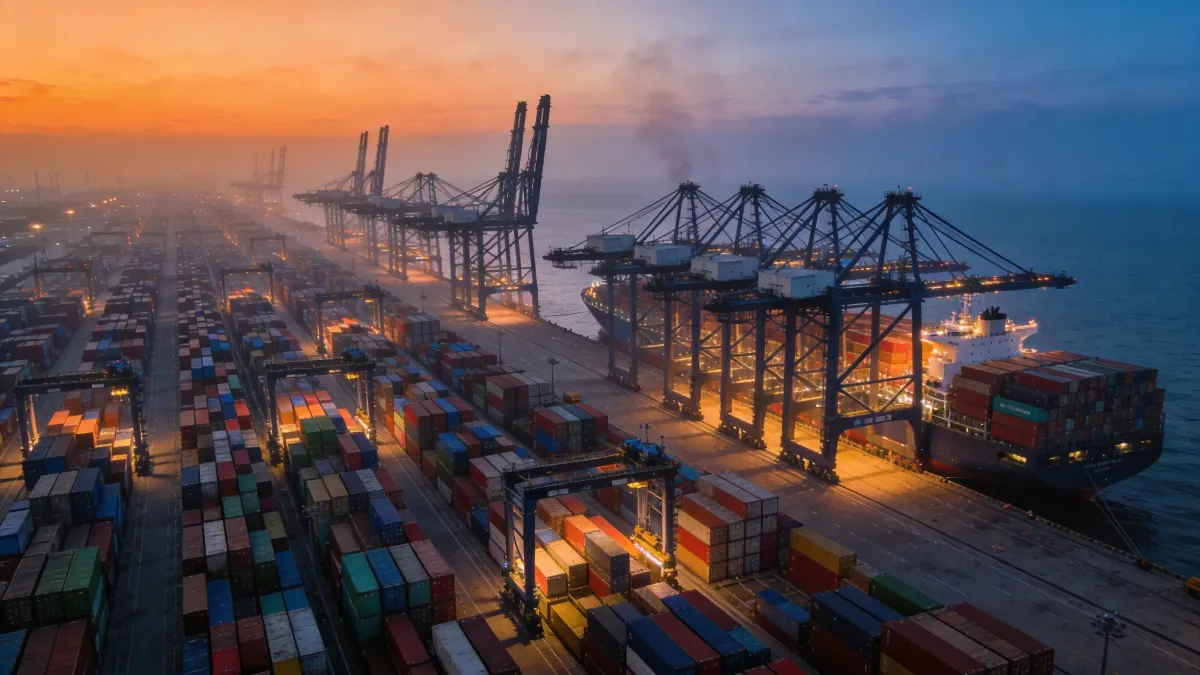
- The Chinese yuan hit its strongest level against the US dollar since 2022 in October 2026, climbing from 6.99 at end-2025 to roughly 6.70 by the end of September 2026.
- Goods priced in yuan now cost a dollar-paying buyer about 4.2% more than in December 2025 — and up to 9% more if Goldman Sachs' 12-month forecast of 6.40 materializes.
- Gulf currencies pegged to the dollar (SAR, AED) absorb the full impact; there is no local-currency shelter.
- Chinese factories are hurting too: Fuyao Glass booked a 1.067 billion yuan FX loss in nine months, which gives importers real room to negotiate cost-sharing.
- The answer is not to stop buying — it is to reprice landed cost at today's rate, lock quotes contractually, and time large orders wisely.
If you import from China and pay in US dollars, a quiet variable has been eating into your margin since early 2026 without any factory formally raising its prices: the yuan has appreciated to its strongest level against the dollar since 2022. Here is what happened, what it costs you on your next container, and the steps we recommend to our clients across the Gulf and the Arab world.
What exactly happened to the yuan in October 2026?
The direct answer: the yuan strengthened from 6.9890 per dollar on 31 December 2025 to 6.7053 on 30 September 2026 — a gain of 4.06% in nine months, according to figures disclosed by Fuyao Glass in its Shanghai Stock Exchange filing and reported by Red Star News on 20 October 2026. In mid-October spot trading the pair touched around 6.69, while the daily central parity fixing stood at 6.7330 on 9 October, per the China Foreign Exchange Trade System (chinamoney.com.cn).
For context: the yuan has risen roughly 10% from its April 2025 trough near 7.35, per Huafu Securities estimates. On 8 October 2026, the People's Bank of China affirmed in a seven-part statement that it sets no target level for the currency and "has no need and no intention" of using depreciation to support exports, as reported by Securities Times.
Against the euro the yuan gained about 7.2% over the same period (8.2071 to 7.6175), landing first on European importers' invoices.
Why is the yuan strengthening when everyone expected weakness?
The first and biggest reason is the record trade surplus: China's September 2026 surplus alone reached $133.5 billion, with exports jumping 36.3% year on year, per Adalytica's analysis of customs data. Every export dollar entering China becomes demand to buy yuan, pushing its price up.
The second reason is that Chinese trade itself is posting historic numbers: the General Administration of Customs announced on 14 October that total goods trade reached 39.94 trillion yuan ($5.97 trillion) in the first three quarters of 2026, up 18.8%, with exports up 16.4%, as reported by Beijing Review on 19 October. High-tech products led the surge: integrated circuit exports soared 99.1% and electric vehicles 72.3%.
The third reason is monetary signaling: Goldman Sachs expects the pair to hold near 6.70 over three months, with a gradual path toward 6.40 over twelve months if exports stay this strong, per Adalytica. The market is not betting on a near-term reversal.
How much will yuan appreciation actually cost you on your next order?
The direct answer: if your supplier prices in yuan — as the vast majority of factories do — goods that cost you $100,000 in December 2025 now cost about $104,246 in September 2026, without the factory raising its price by a single fen. A product priced at 699,000 yuan simply converted into more dollars as the exchange rate moved.
| Date | USD/CNY rate | Source |
|---|---|---|
| 31 December 2025 | 6.9890 | Fuyao Glass filing / Red Star News |
| 30 September 2026 | 6.7053 | Fuyao Glass filing / Red Star News |
| 9 October 2026 (central parity) | 6.7330 | chinamoney.com.cn |
| 17 October 2026 (spot) | ~6.6929 | Adalytica |
| 3-month forecast (Goldman Sachs) | ~6.70 | Adalytica |
| 12-month forecast (Goldman Sachs) | 6.40 | Adalytica |
Here is the same story in trader language. The table below shows the dollar cost of goods priced at 699,000 yuan (about $100,000 at end-2025) at each exchange-rate level:
| Exchange rate | Cost in USD | Increase vs Dec 2025 |
|---|---|---|
| 6.9890 (December 2025) | $100,014 | — |
| 6.7053 (September 2026) | $104,246 | +4.23% |
| 6.40 (2027 scenario) | $109,219 | +9.2% |
A $4,200 gap per $100,000 may look small, but it wipes out the entire net margin in low-margin categories such as consumer goods and building materials, where many traders operate on net margins between 3% and 8%. Based on Keerki Limited's experience in Guangzhou across hundreds of negotiations each year, most Arab traders only notice this gap when comparing two invoices, months apart, for the same product from the same supplier.
Will Chinese factories automatically raise prices because of the strong yuan?
Not necessarily — and this is the most important point to understand. Chinese factories price their output in yuan and are themselves hurt by their currency's strength: Fuyao Glass, the world's largest automotive glass maker, booked an FX loss of 1.067 billion yuan in the first nine months of 2026, versus a 481 million yuan FX gain a year earlier — even as revenue grew 2.46% to 34.1 billion yuan. The factory collects dollars worth less in yuan, exactly as you pay more dollars for the same goods.
The second piece of evidence comes from price data: China's export price index averaged 105.32 in the first eight months of 2026, meaning actual export prices rose about 5% year on year, according to Huafu Securities estimates published in Securities Times. Part of that reflects currency, part reflects upgrading product quality — but practically, the era of the "Chinese price that never moves" is on pause.
The exception is hyper-competitive categories with massive overcapacity (many consumer goods and auto parts), where factories prefer to absorb part of the FX gap rather than lose a long-standing customer. That is exactly where professional negotiation creates value — the work our Keerki team performs daily from Guangzhou for our clients.
What does a stronger yuan mean for the Saudi riyal and UAE dirham?
The direct answer: because the riyal, the dirham and most Gulf currencies are pegged to the US dollar, the yuan's rise against the dollar passes through to them almost in full. According to China's State Administration of Foreign Exchange tables (safe.gov.cn) dated 9 October 2026, 100 yuan bought 55.9 Saudi riyals and 54.7 UAE dirhams, versus roughly 53 riyals at the end of 2025.
In plain terms: a Saudi or Emirati trader has no currency shelter from this move — unlike an Indian importer whose currency moved partly the other way. As an AgroPages report put it on 19 October, you must now compute your net landed cost in your own local currency before judging any quotation.
A tip we repeat at Keerki to every new client: never compare today's quotation against an old dollar invoice and assume the supplier raised prices. Convert both invoices at today's rate first — often the entire "increase" turns out to be currency, not the factory.
Practical steps to protect your margin from yuan swings
Currency is not a disaster; it is a variable to be managed. These are the steps we apply with our clients today:
- Recalculate full landed cost at today's rate: refresh the cost equation (product + freight + customs + storage) with the current rate before every new order.
- Request quotations with defined validity: ask for quotes valid 30–60 days, with the exchange rate used stated in writing, so nobody "remembers" to reprice at payment time.
- Negotiate FX cost-sharing: on large repeat orders, offer to split the exchange-rate difference 50/50 beyond a threshold (say 2%). Factories lose too and usually accept fair formulas.
- Stage your payments smartly: a larger-than-usual deposit at a favorable rate effectively locks part of your cost, instead of paying the full balance on shipment at an unknown rate.
- Consolidate small orders into bigger shipments: larger orders mean stronger leverage on price and payment terms, and lower per-unit freight and clearance cost.
- Ask about yuan settlement for large contracts: several Gulf and Chinese banks now offer yuan accounts and letters of credit, eliminating the double-conversion fees (local → dollar → yuan) that can reach 1–2%.
- Use hedging tools for very large amounts: for contracts worth hundreds of thousands of dollars, ask your bank about forward contracts that fix the rate for 6–12 months for a small premium.
A tip from Keerki: the most common mistake we see now is delaying orders "until the yuan falls back." Forecasts point to more strength, not weakness. Instead of waiting, lock your prices contractually now, and optimize the rest of the cost chain: consolidate shipments, negotiate payment terms, and inspect quality before shipment — so you never pay for returned goods in an even more expensive currency.
Frequently Asked Questions
How much has the Chinese yuan risen against the dollar in 2026?
The yuan gained about 4.06% between 31 December 2025 and 30 September 2026, from 6.9890 to 6.7053 per dollar, per Fuyao Glass's stock-exchange filing. From the April 2025 low, analysts estimate the total rise at roughly 10%.
Does yuan appreciation affect Saudi or Emirati importers?
Yes, directly, because the riyal and dirham are pegged to the US dollar. Any yuan gain against the dollar is automatically a gain against your local currency by almost the same percentage, making yuan-priced Chinese goods roughly 4% more expensive than at the start of the year.
Will Chinese factories raise prices because of their strong currency?
Not necessarily; factories are themselves squeezed and often prefer to absorb part of the gap to keep their customers, especially in highly competitive categories. The export price index did rise about 5% in the first eight months of 2026, but part of that reflects better product quality rather than currency alone.
Can I pay my Chinese suppliers in yuan directly?
Yes, yuan settlement is available and expanding fast through yuan-denominated accounts and letters of credit at Gulf and Chinese banks. The main benefit is eliminating double-conversion fees through the dollar (up to 1–2% of deal value) and fixing your cost in one currency.
Should I delay my orders until the yuan weakens?
Delaying is an uncalculated gamble; Goldman Sachs forecasts keep the pair near 6.70 for the next three months with possible further gains toward 6.40 within a year. The safer path is to buy when needed, lock prices contractually, and share currency risk with your supplier instead of waiting for a bottom that may never come.
How long will Chinese export prices stay elevated?
No one has a definitive answer, but a record $133.5 billion surplus in September alone and 36.3% export growth suggest continued upward pressure on the yuan near term. Watch China's monthly customs releases and the daily fixing on chinamoney.com.cn to catch any reversal early.
Conclusion: the currency is moving — your plan should move with it
The yuan's climb to its strongest level since 2022 is not a passing headline; it lands directly on your next invoice from China: 4% more expensive today, potentially 9% within a year if forecasts hold. The good news: this cost is manageable through smart negotiation, FX risk-sharing, shipment consolidation and payment timing — the tools professional traders use instead of waiting on the market. For the bigger picture, see our earlier analysis of China's trade crossing 5 trillion yuan for the first time in September 2026.
Keerki Limited is a China-based sourcing and commercial representation company headquartered in Guangzhou, helping businesses in the Gulf and the Arab world import from China safely for over 10 years. Our on-the-ground team negotiates with factories on your behalf under terms that protect you from currency and quality surprises. Browse the Canton Fair supplier directory with over 35,000 suppliers, or explore our services from supplier verification to customs clearance. For a quotation updated to today's rates, contact us via the request form or on WhatsApp at +86 133 9212 7362.