- China exported 16.89 million complete motorcycles in January–October 2026, up 12.58% year on year, and export value rose 22.89% to $11.49 billion, according to customs data published by the China Chamber of Commerce for Motorcycle.
- Africa took 6.36 million of those units (+33.07%) worth $3.57 billion (+40.48%), which is where most Arab and African importers compete.
- Motorcycle parts exports reached $5.67 billion in January–September 2026, up 14.6% — the aftermarket is growing almost as fast as the bikes.
- Parts demand arrives 12–24 months after a model lands, so the parts list should be negotiated in the same meeting as the bike order.
- Two checks protect the whole programme: the exact model and engine code, and the supplier's 2027 export-licence status.
Every container of Chinese motorcycles that clears customs in Jeddah, Alexandria, Lagos or Basra creates a second business: the parts that keep those bikes running. In 2026 it grew almost as fast as the first, and it carries better margins. Chinese factories shipped 16.89 million complete motorcycles in the first ten months of 2026, 12.58% more than a year earlier, while the value of those shipments rose 22.89% to $11.49 billion, according to customs statistics published by the China Chamber of Commerce for Motorcycle on 24 November 2026. If you sell bikes, you are already in the parts business — whether or not you have ever stocked a single sprocket.
What do the 2026 export numbers say, and why does the parts window open in 2027?
Chinese motorcycle exports are growing in value faster than in volume, which means buyers are moving up in specification rather than simply adding units. Africa is the clearest example: in January–October 2026 the continent imported 6.36 million Chinese motorcycles, up 33.07%, worth $3.57 billion, up 40.48% — the fastest growth of any region in the chamber's data. On the January–September figures, Africa's average import price worked out to roughly $558 per unit against about $678 for all destinations, a gap that tells you what kind of bikes are being sold: 100–200cc commuter and cargo models that work hard and wear out fast (Shanghai Securities News, 2 November 2026).
The parts side is moving on the same track. China's motorcycle parts exports reached $5.67 billion in January–September 2026, up 14.6%, while electric two-wheeler exports hit 26.04 million units (+28%) worth $7.26 billion (+37.8%), with shipments to Africa up 76% (China National Radio / International Business Daily, 19 November 2026). Electric bikes are a parts story in themselves: controllers, throttles, displays, chargers and battery packs fail in the heat, and local workshops cannot repair them.
There is a supplier-side reason to plan the 2027 order early as well. Chinese motorcycle manufacturers earned RMB 119.91 billion of revenue in January–August 2026, up 11.95%, but total profit rose only 0.55% to RMB 8.24 billion. A factory that cannot earn on the bike is far more willing to discuss parts pricing, minimum quantities and packaging terms.
Timing matters because the first failure cycle starts after roughly a year of daily use and peaks in the second. An importer who ships 500 bikes and no parts hands the aftermarket to local shops that source grey imports, copy parts or strip used machines; two years later the model has a reputation for "no parts available" that makes the next container harder to sell.
Which parts fail first in Gulf heat and African road conditions?
Friction, sealing and electrical parts fail first, and they fail earlier in 45°C heat, dusty air and overloaded cargo use than in the mild conditions the factory tested for.
| Part group | Typical first demand | Why it fails early | Stocking note |
|---|---|---|---|
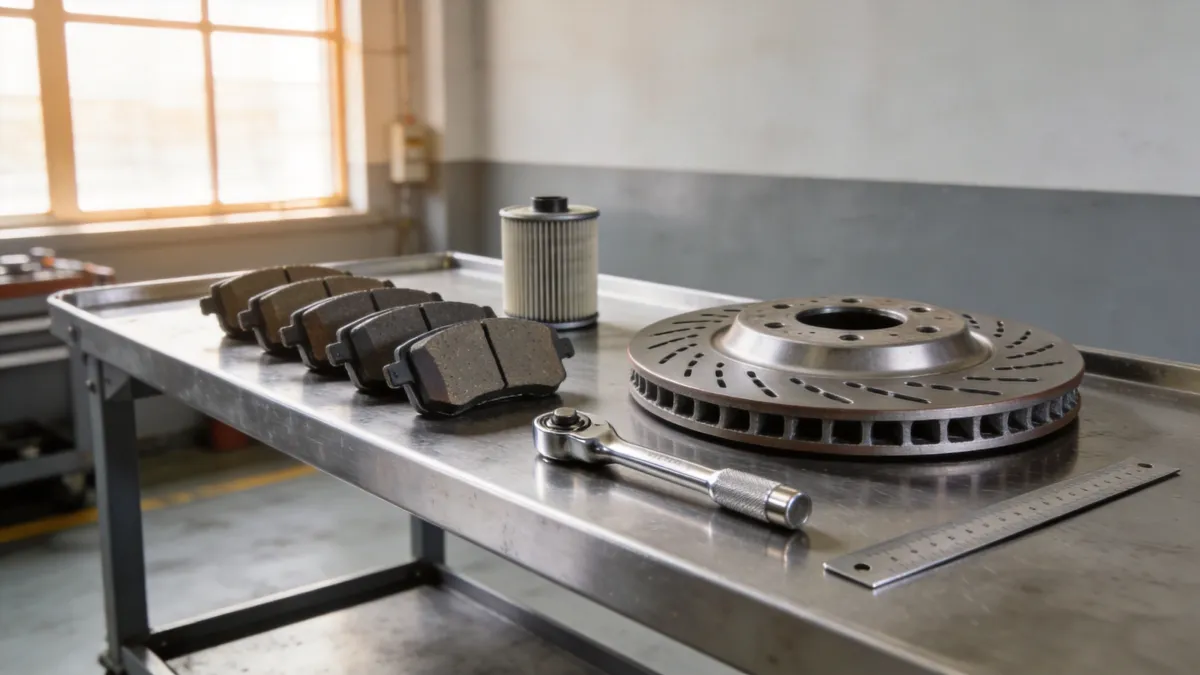
| Brake shoes and pads | 6–12 months | Dust, heat glazing, heavy loads | Highest turnover; buy by axle set, not by piece |
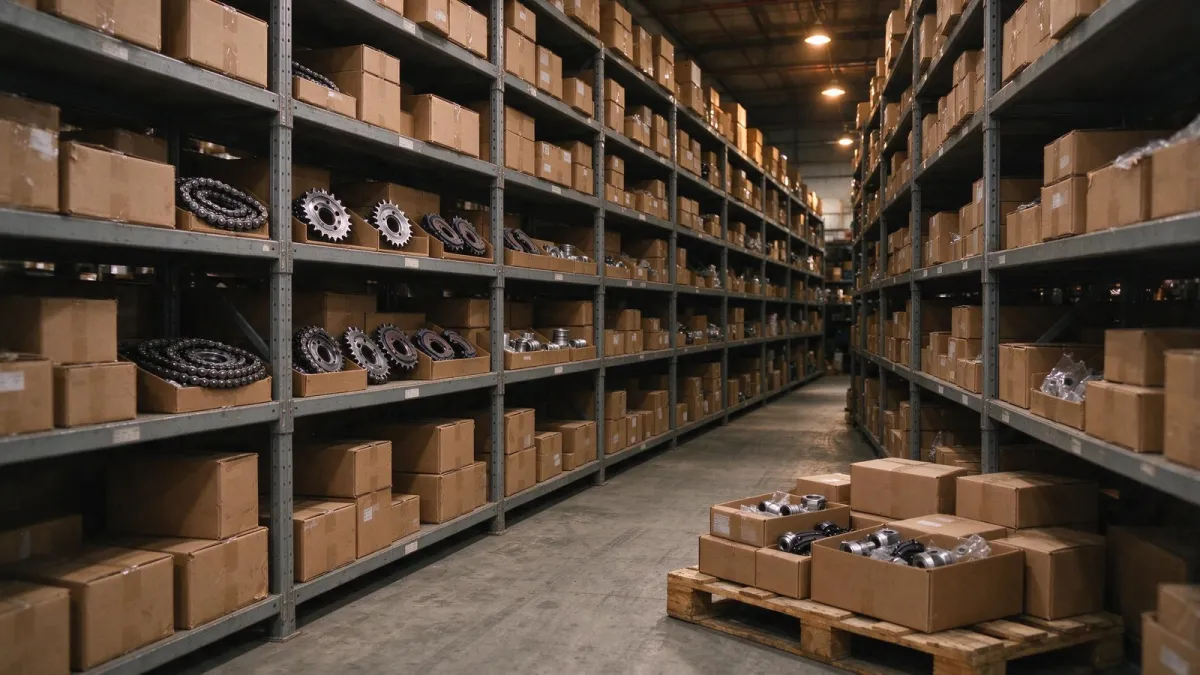
| Drive chain and sprockets | 8–14 months | Dust, poor lubrication, cargo weight | Sell chain and both sprockets as one kit |
| Clutch plates and springs | 10–18 months | Stop-and-go traffic, passenger overload | Match plate thickness to the model year |
| Air filter and spark plug | 1–3 months | Dust and humidity | Cheapest way to keep a customer visiting |
| Bearings and oil seals | 10–20 months | Water crossings, dust ingress | Buy branded bearings; cheap ones come back twice |
| Lighting, CDI, regulator, harness | 6–18 months | Heat, vibration, voltage spikes | Electrical faults are the top warranty complaint |
| Tyres and tubes | 12–24 months | Heat, load, rough surfaces | Bulky: ship inside the bike container, not alone |
| E-bike controller, charger, battery | 8–20 months | Heat and charging habits | Match voltage and connector, not just the model |
Treat those timings as planning windows, not fixed rules: a delivery fleet in Lagos wears brakes twice as fast as a private commuter in Muscat. List the twenty parts your own market asks for, then check which of them your supplier already makes for the exact model you import.
How do you match parts to the exact models you import?
Match parts by model code, engine code and drawing — never by the name on the fuel tank, because one name can cover three platforms.
Start from the model code and VIN prefix
Chinese factories sell the same 150cc platform under several names to different importers. Ask for the factory model code and the VIN prefix on the bikes you already received, then ask the parts supplier to confirm fitment in writing on the invoice, not in a chat message.
Confirm the engine code, not the displacement
Two 200cc engines can use different clutch plates, gaskets and jets. The engine code stamped on the crankcase is the only reliable identifier, and it is what a local mechanic quotes when he orders.
Use drawings and one physical sample
For friction and drivetrain parts, ask for the drawing with dimensions: outer diameter, inner diameter, thickness, tooth count, link count. Then buy one sample set per number and fit it on a bike in your workshop before the bulk order. A container of sprockets with the wrong spline is worth scrap metal.
What should the first parts order contain?
Build the first order in three layers: a service layer that sells quickly, a repair layer that protects the warranty, and a small problem layer that solves what local shops cannot.
| Layer | Contents | Share of the first parts budget | Purpose |
|---|---|---|---|
| Fast service layer | Air filters, spark plugs, oil seals, brake shoes, chains, cables, bulbs | Largest share | Cash flow and repeat visits |
| Repair layer | Clutch plates, piston kits, gaskets, bearings, sprockets, carburettor parts | Second layer | Keeps warranty work in your own workshop |
| Problem layer | CDI units, regulators, harnesses, switches, mirrors, plastics, e-bike controllers | Small reserve | Solves failures nobody else can supply |
Keep the number of part numbers small and the quantity per number realistic. Ten numbers that sell out beat four hundred that sit on a shelf, and minimums are usually negotiable when your numbers are already in the factory's production plan.
Practical steps, and the supplier check most importers skip
Most importers check the price list and skip the export-licence list, yet under China's export-licence system complete motorcycles are shipped by companies that appear on the annual list published by the Ministry of Commerce. For 2027, the list of companies qualified to apply for motorcycle export licences was published for public comment between 17 and 24 November 2026 (Ministry of Commerce notice, republished by the China Chamber of Commerce for Motorcycle). A trader that is not on that list will route your order through a licensed exporter, which adds a layer between you and the factory and makes parts traceability harder. Ask for the factory name, then check whether that name is on the list.
- List the models sold in the last 24 months with their factory codes and VIN prefixes.
- Collect the twenty parts most requested by your workshop, with photos of the worn parts.
- Ask each shortlisted supplier for a written parts price list for those exact models, and compare it with the supplier directory to see who actually produces that platform.
- Request drawings for friction and drivetrain parts, then order one sample set per number.
- Fit the samples in your workshop and record the result before paying for bulk.
- Negotiate parts pricing and minimums with the next bike order — that is when you have leverage.
- Ship parts inside the bike container where possible, to avoid a second freight bill and customs entry.
- Set one reorder rule: when a fast-moving number falls below two months of sales, reorder it.
From the Guangzhou sourcing desk at Keerki (Keerki Limited): ask the factory for the parts catalogue of the previous model year as well. Chinese manufacturers refresh plastics, lighting and electrical parts almost every season, and a part that fits the 2026 bike often will not fit the 2025 one. Importers who receive only the current catalogue end up unable to service the bikes they sold in 2025, which is the most expensive gap in this business. Factories in Chongqing, Jiangmen and Wuxi — the clusters described in our China city guide — can usually supply both catalogues on request.
Frequently Asked Questions
Is it cheaper to buy motorcycle spare parts from a factory or from a parts trader in China?
A factory is cheaper for the numbers it actually produces; a trader is cheaper for a mixed order covering twenty brands. Buy fast-moving numbers from the factory that builds your bikes and fill the gaps from one reliable trader.
What is a realistic minimum order for a first motorcycle parts shipment?
One that fits the space left in a bike container and covers roughly twenty to forty part numbers. Minimums are set per part number, so the total value matters less than how well the numbers are chosen.
How long does production take for Chinese motorcycle parts?
Standard parts already in the factory's schedule take two to four weeks; custom packaging adds one or two. Parts for a discontinued model take longer, which is why the commitment is agreed before the model is phased out.
Do Chinese motorcycle parts need certification for Gulf markets?
Complete vehicles and safety-related components are regulated in Gulf markets, and the importer normally carries the conformity obligation. For Saudi Arabia this means SASO and its SABER platform; for the UAE it means MoIAT, with GSO standards used across the region. Check the applicable requirement with your conformity provider before shipping, because it differs by product and by market.
Why do the same parts cost different amounts from different Chinese suppliers?
Because material and process differ even when the drawing is identical: bearing grade, friction material, plating thickness and heat treatment all move the price. Ask for the specification, not only the price, and compare two samples.
Can I sell Chinese motorcycle parts under my own brand?
Yes. Most factories will print your brand on boxes, labels and manuals for a modest minimum, and many will mould your name into plastic covers. Keep the factory model code so you can reorder the identical part two years later.
Conclusion: the parts margin is decided before the bikes ship
The 2026 numbers make the direction clear: exports grew 12.58% in volume and 22.89% in value in ten months, and parts exports grew 14.6% in nine. The importers still selling these brands in 2028 are the ones who negotiated the parts list before the bikes left the factory.
Keerki Limited is a China-based sourcing and commercial representation company headquartered in Guangzhou, helping businesses in the Gulf and the Arab world import from China safely for over 10 years.
If you are planning a motorcycle or parts order for 2027, send your model list to our team through the Keerki request page or on WhatsApp +86 133 9212 7362, and we will match it against factories in Chongqing, Jiangmen and Wuxi before you commit to a container. Our sourcing services cover inspection, consolidation and shipping in one sequence.