- The 32nd China Yiwu International Commodities Fair opened on October 21, 2026 with 2,770 exhibitors and 4,500+ booths, running through October 24 at the Yiwu International Expo Center.
- Yiwu's exports reached 548.85 billion yuan in January–August 2026, up 12.8% year on year per Yiwu Customs — the "world's supermarket" remains the first source for small commodities.
- This edition includes a sourcing matchmaking session dedicated to the Middle East — organizers are actively courting Arab buyers.
- The late-September China–U.S. deal on $30 billion in reciprocal tariff cuts covers toys, home appliances, baby products and holiday gifts, freeing factory capacity that can be redirected to markets like the Gulf.
- Even if you miss the four-day fair, Yiwu's permanent Futian Market operates all year, and you can buy from it remotely through a trusted local agent.
While attention was fixed on Guangzhou and the Canton Fair this week, the city of Yiwu in Zhejiang opened the doors of the world's largest annual gathering for small commodities. The Yiwu International Commodities Fair is the clearest window into what will fill shop shelves across the Gulf and the Arab world in the coming seasons. Here we read the new edition's numbers, explain why they matter to you as an Arab importer, and show how to move whether you attend or buy from your desk.
What happened in Yiwu this week? The 32nd fair in numbers
The Yiwu Fair opened on October 21, 2026, covering 110,000 square meters across nine indoor halls plus an outdoor hall, with 2,770 companies from twenty Chinese provinces and 4,545 standard booths, according to China's CCTV and the organizing committee. Organizers expect more than 180,000 buyer visits, including over ten thousand international purchasers.
The notable shift this year is the weight of the daily consumer goods section: more than 1,800 booths for this category alone, up 36.67% from the previous edition, alongside sections for hardware, electronics, toys, sports goods and office supplies. A new "premium export products" zone gathers 162 companies with goods already proven overseas.
Most relevant for Arab readers: the fair's schedule includes a "Jinmao Global" sourcing matchmaking session dedicated to the Middle East and ASEAN, per the Yiwu city government's published program — a negotiation table with factories set specifically for Arab buyers.
Beyond the fairground, official figures confirm the city's weight: Yiwu's exports reached 548.85 billion yuan between January and August 2026, up 12.8% year on year according to Yiwu Customs, while the city's cross-border e-commerce transactions hit 127.53 billion yuan over the same period. Yiwu also hosted 37 trade exhibitions in eight months, drawing 1.36 million professional buyer visits.
Why does the Yiwu Fair matter specifically to Arab importers?
Because Yiwu is the world's primary source for the fast-moving small commodities that form the backbone of retail in our markets: household essentials, school and office supplies, toys, accessories, and celebration decor. According to Xinhua, Yiwu alone supplies roughly 80% of the global holiday-goods market, shipping more than 20,000 product varieties to 178 countries and regions every year. That is exactly the merchandise mix behind Gulf wholesale shops, Ramadan and Eid seasons, and back-to-school campaigns.
There is also an important price signal: during the eighth round of China–U.S. economic consultations (September 20–23, 2026), both sides agreed on product lists for $30 billion in reciprocal tariff reductions, with the U.S. side covering toys, home appliances, baby products, kitchen and bathroom goods, and holiday gifts. What does that mean for you? As American orders return with force — Yiwu's exports to the United States already grew 25.1% in 2025 to 104.51 billion yuan — global markets compete for the same factory capacity. Importers who lock in production early with clear contracts get the price and the delivery commitment; those who wait pay the congestion premium.
Xinhua's reporting also highlights a structural shift: Yiwu traders have widened their customer base to more than thirty countries while investing in smarter, higher-margin products — meaning a broader range of value-added goods for the Arab importer. And with holiday merchandise still being ordered in October rather than the usual summer peak, per CCTV, the old buying calendar can leave you ordering late — when freight is pricier and factory slots are gone.
Yiwu Fair vs. Futian Market: where do you actually buy?
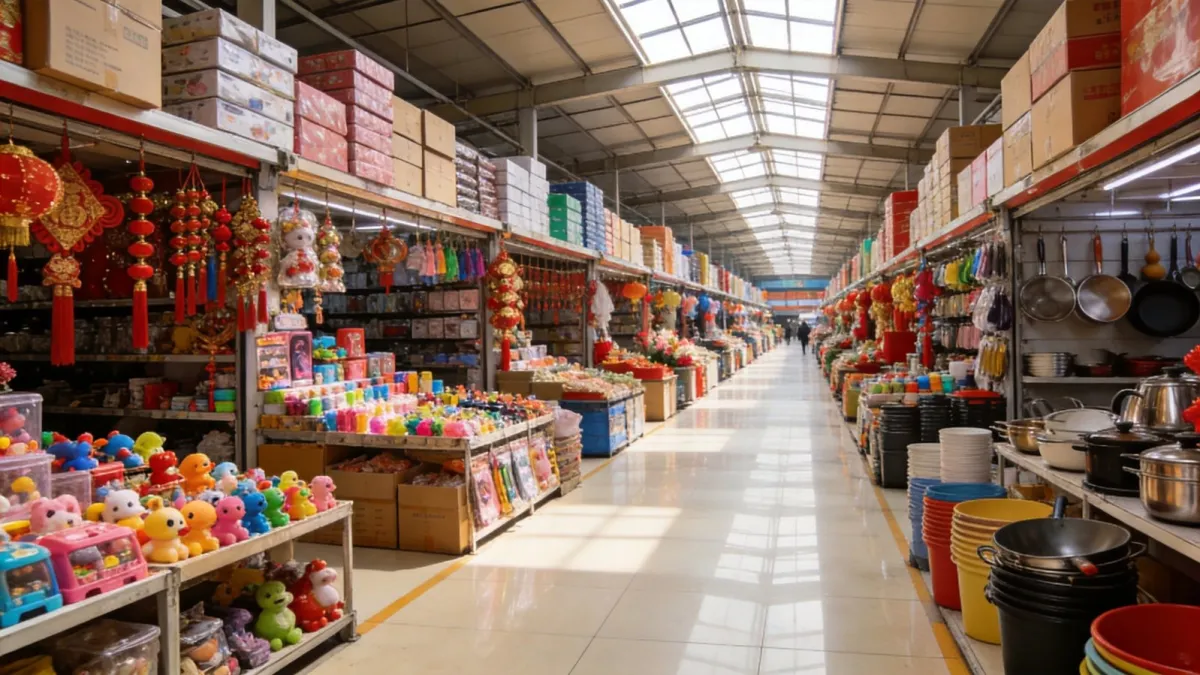
The Yiwu Fair is a temporary four-day event for spotting new products and meeting factories, while year-round purchasing happens at the Futian Market — the International Trade City, the world's largest permanent wholesale market for small commodities with tens of thousands of shops organized into specialized districts. The smart buyer uses the fair to map trends and new suppliers, then returns to the permanent market to close deals and compare prices.
The table below summarizes Yiwu's buying map based on published market guides:
| District | Main product categories | Best for |
|---|---|---|
| District 1 | Toys, artificial flowers, fashion jewelry and accessories, holiday decor and crafts | Toy traders, gift shops, celebration-decor importers |
| District 2 | Hardware and tools, luggage and umbrellas, small home appliances, electronics and lighting | General-merchandise and small-appliance importers |
| District 3 | Stationery and school/office supplies, eyewear, cosmetics and sports goods | School-supply and beauty traders |
| District 4 | Socks, gloves, hats, scarves and everyday textiles | Textile and basic-apparel importers |
| District 5 | Imported goods, bedding and home textiles, hotel and automotive supplies | Home-textile and hospitality-supply importers |
| District 6 (newest) | Trendy toys, baby products, skincare, smart devices and travel goods | Buyers hunting higher-value trending products |
From Keerki Limited's field experience in Zhejiang's markets, the most common mistake Arab traders make is trying to cover the whole market in one day. The rule: pick at most two districts matching your business and dedicate a full day to each.
How does your cargo travel from Yiwu to the Gulf and the Arab world?
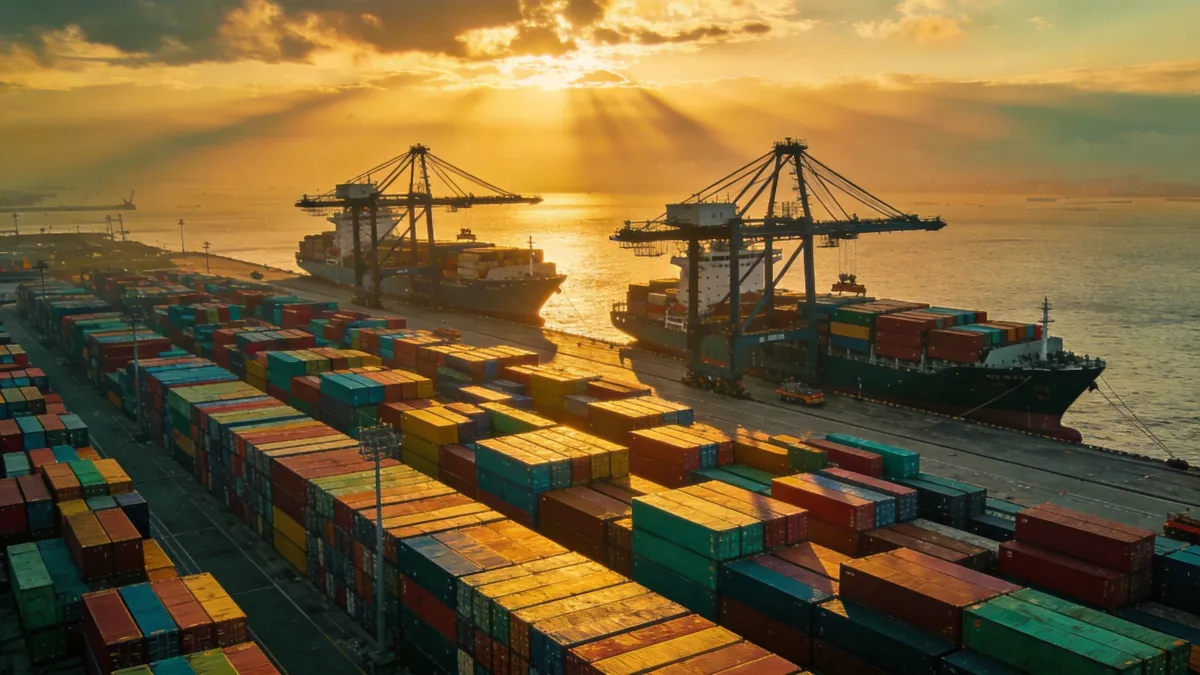
Yiwu has a mature export logistics infrastructure. Sea freight via Ningbo–Zhoushan Port is the most economical option for Arab-bound cargo, connected to Yiwu by a sea–rail intermodal channel. The city is also the origin of the Yiwu–Xinjiang–Europe freight trains, which carried 200,460 TEUs through October 7, 2026 across 27 routes covering 160+ cities in 50+ countries, per Hangzhou Customs data on Zhejiang's official portal.
| Logistics option | Typical route | When to choose it |
|---|---|---|
| FCL sea freight (full container) | Yiwu → Ningbo–Zhoushan → Gulf ports (Jebel Ali, Dammam, Duqm) | When your order volume fills a container; lowest cost per kilo |
| LCL sea freight (consolidation) | Consolidation warehouse in Yiwu or Ningbo, then shared container | For multi-shop purchases in small quantities |
| International rail | Yiwu → Central Asia → Europe | For cargo bound for Europe or Central Asia, not the Gulf |
| Air freight | Yiwu airport or Hangzhou/Shanghai hubs | For urgent samples and light, high-value goods |
A practical point many overlook: Yiwu shops typically do not handle export themselves — they sell to you "delivered to a local warehouse." You therefore need someone to receive goods from dozens of different shops, inspect them, re-pack where needed, and consolidate everything into one container with correct documentation. That is precisely the cargo consolidation and pre-shipment inspection service Keerki's team performs daily for Arab importers, so your container arrives with contents matching the invoices — no surprises.
Practical steps: how to benefit from the Yiwu Fair and market — even from your desk
- Define your product list first: write down 10–20 items with specifications, quantities and reference photos; a negotiation without a written spec ends at a tourist price.
- Check the exhibition calendar before traveling: follow our China exhibitions page to match your visit with the right fair.
- Research the directory before arrival: browse the supplier directory of 35,000+ suppliers to build a shortlist, then verify candidates on the ground or through an agent.
- Request real samples, not catalog photos: only a sample from the actual production line reveals quality — far cheaper than returning a full container.
- Negotiate by the carton, not the piece: most items sell by the carton or dozen; fix packing and pieces-per-carton literally on the invoice to avoid disputes.
- Don't manage export remotely by yourself: appoint someone to receive, inspect, consolidate and document the goods, via our service request form.
- Plan your seasons on the Chinese calendar: account for Chinese New Year shutdowns and order seasonal merchandise two to three months ahead.
A tip from Keerki: the costliest problem we see for Arab traders in Yiwu is not price — it is "scattered buying": dozens of small shops, each delivering at a different time and quality. The fix is one party that receives, inspects and consolidates. At Keerki we visit fairs and markets on clients' behalf, document samples with photos and video before payment, then inspect and consolidate goods before shipping.
Frequently Asked Questions
What is the difference between the Yiwu Fair and the Yiwu market (International Trade City)?
The Yiwu Fair is a temporary four-day event for discovering new products and meeting factories, while the International Trade City (Futian Market) is a permanent wholesale market operating all year. Most deals close in the permanent market; the fair maps trends and new suppliers.
Can I import from Yiwu without traveling to China?
Yes, you can buy from Yiwu without traveling through a local sourcing agent who negotiates on your behalf, receives and inspects the goods, and ships them to you. Thousands of Arab importers have used this model for years, and Keerki Limited provides this service from inside China with a team speaking Arabic, Chinese and English — from supplier search to customs clearance.
What is the minimum order quantity in Yiwu's markets?
Yiwu's market is known for very low minimums compared with factories — many items sell by a single carton or a few cartons, ideal for testing new products at limited risk. Pricing improves noticeably with volume, and each shop's terms must be fixed on the invoice.
How do I ship my goods from Yiwu to Gulf countries?
The most common route is sea freight via Ningbo–Zhoushan Port, linked to Yiwu by a sea–rail intermodal channel, then sailing to Gulf ports such as Jebel Ali, Dammam and Duqm. If your purchases come from multiple shops, consolidate them in one warehouse and ship a single container instead of costly fragmented shipments.
Are Yiwu prices cheaper than Guangzhou?
For small commodities, toys, accessories and celebration decor, Yiwu usually offers the widest assortment and the lowest minimums, while Guangzhou leads in electronics, fabrics and other categories. It is less a rivalry between two cities than a matter of specialization: choose the city according to your product category, and check our China factory map to see where each product is actually made.
When is the best time to visit Yiwu or order from it?
The best timing is two to three months before the selling season in your country, while accounting for Chinese New Year shutdowns that halt production for weeks. If you target a major season such as Ramadan or back-to-school, start negotiations and sampling very early, because capacity at good factories is booked long before the season begins.
Conclusion: Yiwu is opening its doors — are you ready to walk in?
The 32nd Yiwu Fair is not domestic Chinese news; it is a direct indicator of what your suppliers will offer next season and at what prices. The Middle East–dedicated matchmaking sessions tell you the market is looking for you just as you are looking for it. Importers who read these signals early win on price, quality and timing together.
Keerki Limited is a China-based sourcing and commercial representation company headquartered in Guangzhou, helping businesses in the Gulf and the Arab world import from China safely for over 10 years. Our team speaks Arabic, Chinese and English, and accompanies you from product selection in Yiwu or any Chinese market, through supplier visits, quality inspection and cargo consolidation, to shipping and customs clearance. Contact us via our service request form or WhatsApp +86 133 9212 7362. Planning a trip? Review our China city guide and our guide to finding reliable suppliers first.