- China's auto parts exports reached $79.6 billion in the first nine months of 2026, up 10% year on year, and September alone hit $9.77 billion, up 24% — according to China Passenger Car Association data.
- Chinese car brands now hold over 20% of GCC new-car sales, and BYD alone accounts for roughly 60% of the Middle East EV market — driving fast-growing demand for EV spare parts.
- China reinstated a 2% consumption tax on lithium-ion batteries in September 2026 and will scrap the battery export tax rebate in January 2027 — order timing is now a pricing factor.
- Batteries and charging components ship as Class 9 dangerous goods, requiring UN38.3 certification, special booking, and longer lead times.
- The landed cost of an EV part is built from six cost blocks; importers who model them in advance protect their margins.
Every week, more Chinese electric and plug-in hybrid cars land on the streets of Riyadh, Jeddah, Dubai and Doha — and every car sold today creates tomorrow's demand for batteries, chargers, e-motors and electronic components. The question we hear at Keerki Limited almost daily: what does it actually cost to import EV spare parts from China into the Gulf, and is the margin worth it? This guide answers with verified October 2026 data, block by block.
Why Are Gulf Importers Rushing Into Chinese EV Spare Parts Now?
Because the Gulf's car parc is changing at record speed, and spare parts always follow the sold fleet, not the headlines. Market data updated in October 2026 shows Chinese brands above 20% of new-car sales across the GCC, while Saudi EV sales grew 78% in 2025 to roughly 44,800 units, with BYD holding close to 60% of the Middle East EV market.
The momentum is confirmed on the export side: BYD's Saudi sales surged 277% year on year in H1 2026, and BYD shipped more than 22,400 cars to the UAE in the first eight months of 2026 — mostly plug-in hybrids — according to the Gasgoo export database. The Gulf as a whole imported about $7.4 billion worth of Chinese EVs in 2025, up 92% year on year.
Meanwhile, Chinese parts supply is at historic highs: auto parts exports totalled $79.6 billion in the first three quarters of 2026, up 10%, with September alone at $9.77 billion, up 24%, as CPCA secretary-general Cui Dongshu noted in his September review. Gulf demand is accelerating while Chinese supply is at its peak — an ideal window for importers with the right numbers.
What Exactly Falls Under "EV Spare Parts"?
The EV parts market covers four families that differ radically in how they ship, clear customs and are priced. Mixing them in one container without understanding the differences is the most common first-timer mistake.
| Parts family | Examples | Shipping & compliance sensitivity |
|---|---|---|
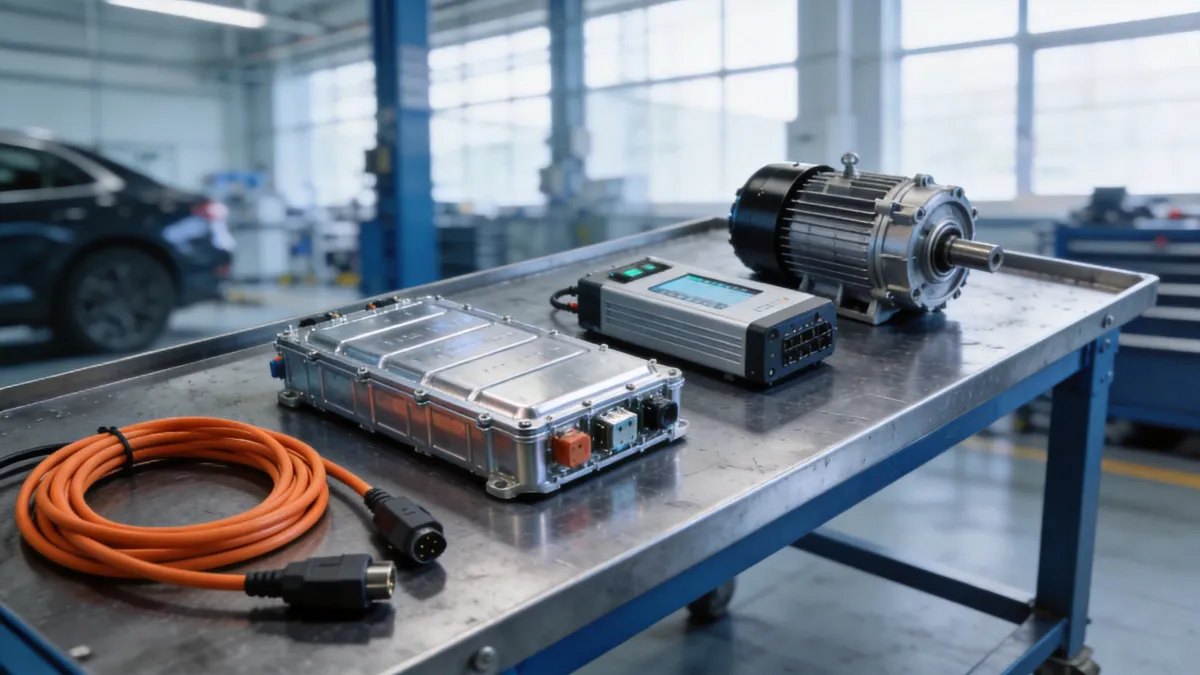
| Power & battery components | Lithium battery packs and modules, battery management systems (BMS), replacement cells | Very high: Class 9 dangerous goods, mandatory UN38.3 certification, special DG booking |
| Charging systems | Home wallbox chargers, DC fast chargers, charging cables and adapters | Medium to high: conformity certificates and EMC testing required in some markets |
| Electric drive & power electronics | E-motors, inverters, control units, on-board chargers (OBC) | Medium: mostly regular freight with technical conformity requirements |
| General electrical & body parts | Sensors, cameras, displays, LED lighting units, body panels for Chinese models | Relatively low: similar to conventional car parts for shipping and clearance |
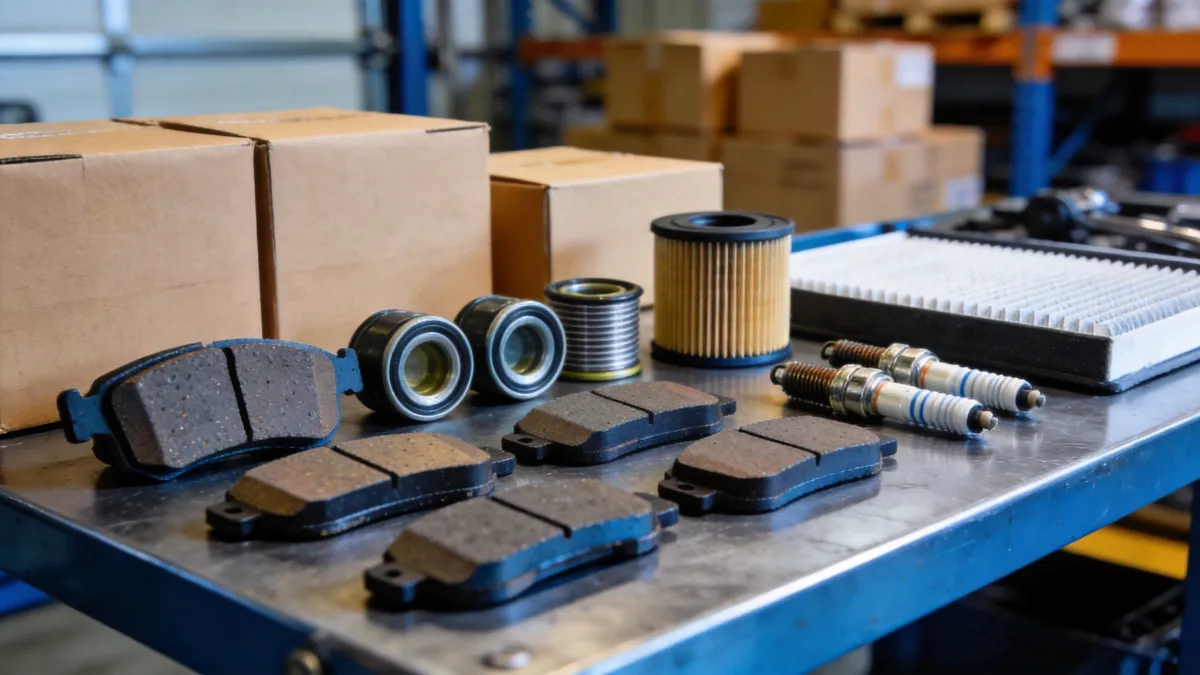
A practical rule from our Guangzhou office: start with one family you understand well. Most successful wholesalers we serve at Keerki began with fast-moving service parts for specific models — filters, brake pads and suspension parts for Haval, Jetour and MG — then moved into higher-margin electrical components after building their workshop customer base.
What Does It Really Cost? The Landed Cost, Block by Block
The factory price (FOB) is typically only half to two-thirds of what a part finally costs in your Gulf warehouse. The rest is six cost blocks that must be modelled before you sign any purchase order — the same map we use with our clients:
| Cost block | What it covers | How to control it |
|---|---|---|
| 1. Factory price (FOB) | Unit price from the factory to the Chinese loading port, including export packaging | Negotiate MOQs, quote at least three factories, and verify the supplier is a real manufacturer, not a middleman |
| 2. Pre-shipment inspection | Inspection team fees, sample testing, conformity reporting | Mandatory for batteries and chargers in particular; far cheaper than a rejected container |
| 3. International freight | Container or air freight rates, plus dangerous goods surcharges on batteries | Consolidate shipments, pick the port closest to the factory, and book DG space early — it is limited |
| 4. Insurance & documentation | Cargo insurance, certificate of origin, UN38.3 and MSDS documents for batteries | Verify documents before departure, not after arrival |
| 5. Customs & conformity fees | GCC customs duty typically starting at 5% in most member states, plus platform fees such as SABER in Saudi Arabia and conformity certificates | Register products on SABER early and confirm the correct HS classification for every part |
| 6. VAT & inland costs | VAT (15% in Saudi Arabia, 5% in the UAE), inland transport, warehousing | Treat it as working capital, not as margin |
One point many importers miss: VAT in most Gulf states is calculated on the CIF value plus customs duty, so every freight dollar also raises your tax base. Air-freighting a light, expensive component can sometimes cost less in total than slow sea freight — even though the air rate looks higher on paper.
What Did China Change in 2026, and How Does It Hit Your Prices?
Three Chinese policy shifts this year touch the cost of the EV parts you import, according to a Nikkei Asia report published on 16 October 2026:
- The battery consumption tax is back: since 1 September 2026, China has reimposed a 2% consumption tax on lithium-ion batteries after an 11-year exemption, rising to 4% in September 2027. Major battery makers have already started passing it into sales prices.
- The battery export tax rebate is ending: cut from 9% to 6% in April 2026, it disappears entirely in January 2027, adding pressure on battery export prices in the coming months.
- Export momentum protects competitive pricing: despite the taxes, China's EV exports rose 72.3% and lithium battery exports 36.4% in the first three quarters of 2026, per China Customs, and September battery shipments hit 44.0 GWh, up 64.5%, per the China Automotive Power Battery Industry Innovation Alliance. Abundant supply keeps competition working in the buyer's favour.
The practical takeaway: if you plan to enter batteries and charging hardware, Q4 2026 — before the export rebate ends — is a better pricing window than H1 2027, especially with the pre-Chinese-New-Year demand peak approaching.
Practical Steps for a Successful First EV Parts Shipment
Your first shipment defines your reputation. Follow the sequence we apply with new clients:
- Define target models precisely: review your country's sales data (BYD Song Plus, Jetour T2 and Haval H6 lead Gulf charts) and build your list on a real fleet, not guesswork.
- Classify parts by shipping sensitivity: separate batteries and anything with lithium cells from the rest at the planning stage — they need DG booking and extra documents.
- Test samples before the big PO: especially chargers and control units; fit them on an actual car of the target model.
- Verify the supplier: check the licence, export record and production-line ownership; fake factories are more common in electrical parts.
- Prepare compliance early: register products on SABER via the Saudi Standards, Metrology and Quality Organization (SASO), and have UN38.3 and MSDS ready two weeks before shipping.
- Model the full landed cost before signing: use the six-block table, add a 10% safety margin, and only then set your selling price — not the reverse.
A tip from Keerki: the most expensive mistake we see here is buying "compatible" parts for recent Chinese models without verifying the OE part number. Many BYD, Geely and Chery models update components every few months, so a part fitting a 2025 batch may not fit the 2026 batch of the same model. In our Guangzhou office we cross-match part numbers against Chinese dealer databases before approving any supplier — which once saved a client an entire container of mismatched parts. Browse auto parts suppliers in the Keerki directory, then let us handle verification and matching.
Frequently Asked Questions
Is importing lithium batteries from China to the Gulf legal?
Yes, it is legal but regulated as Class 9 dangerous goods. You need a UN38.3 test certificate and an MSDS from the factory, a dangerous-goods booking, and compliant packing. Most delays we see come from missing documents, not customs refusals.
How long does shipping from China to Gulf ports take?
Sea freight from South China to Jebel Ali or Jeddah typically takes two to five weeks depending on the carrier, plus clearance days. Battery cargo needs longer booking lead times because DG space is limited, so book early, especially before Chinese New Year.
Do I need SABER certification to import auto parts into Saudi Arabia?
Yes. Most auto parts for Saudi Arabia fall under the SABER platform run by SASO, requiring a product certificate plus a shipment certificate per consignment. Chargers and similar electrical parts face extra technical requirements. Early registration saves days at clearance.
Will Chinese battery prices rise after the export rebate ends in January 2027?
Battery export prices will likely face limited upward pressure: the rebate fell from 9% to 6% in April 2026 and ends in January 2027, alongside the 2% consumption tax reimposed in September 2026. Overcapacity and fierce competition among Chinese factories should absorb part of the impact, so expect gradual, negotiable increases rather than sharp jumps.
Which Chinese car models should I build my parts stock around?
Build your stock on the actual fleet in your country: in Saudi Arabia and the UAE, models such as the Jetour T2, BYD Song Plus, MG ZS and Haval H6 top the charts, and BYD's Saudi sales grew 277% in H1 2026. Start with fast-moving service parts for these models, then add higher-value electrical components gradually.
How do I make sure a supplier is a real factory, not a fake trader?
Verification has three layers: checking the business licence and registered capital, visiting the factory in person or through a trusted local team, and matching samples against original part numbers. That is what the Keerki team does daily from Guangzhou — before the client pays any deposit.
Conclusion: A Real Opportunity for Those Who Do the Math
The Gulf market for Chinese EV spare parts is not a passing wave; it is the logical consequence of tens of thousands of Chinese cars that entered the region's roads over the past two years and now need maintenance. Every data point points the same way: record Chinese parts exports, a swelling Gulf fleet, and tax changes that reward early movers. What separates a profitable importer from a losing one is not the factory price — it is the accuracy of the six-block cost model and the quality of supplier verification.
Keerki Limited is a China-based sourcing and commercial representation company headquartered in Guangzhou, helping businesses in the Gulf and the Arab world import from China safely for over 10 years. We find and verify suppliers, visit factories, inspect quality before shipment, consolidate cargo and handle customs clearance — saving you weeks of trial and error at a fraction of the cost of one failed container. Browse our services or the China guide, then reach us via the request form or directly on WhatsApp +86 133 9212 7362 — a team speaking Arabic, Chinese and English will answer you.