- China exported USD 95.72 billion of auto parts in 2025, up 2.5% year on year, according to China's General Administration of Customs.
- The GCC automotive aftermarket is worth about USD 10.69 billion in 2025 and is forecast to reach USD 15.32 billion by 2032 — with fast-moving parts (brakes, filters, spark plugs) driving repeat demand.
- Chinese factory prices for ceramic brake pad sets start around USD 2–6 per set with MOQs of 50–100 sets on Chinese B2B platforms.
- Importing auto parts into Saudi Arabia requires SABER product and shipment certificates under SASO's Technical Regulation for Auto Spare Parts.
- Sea freight from South China ports to Jeddah typically takes 16–22 days port-to-port; plan 30–45 days door-to-door.
When a first-time importer asks me what to start with when sourcing from China, my answer is almost always the same: start with what wears out every day. Nothing wears out more predictably than brake pads, filters and spark plugs — every workshop reorders them constantly, and demand tracks the entire vehicle parc rather than one model year. This guide covers the full process: real market numbers, live price ranges, Gulf conformity rules, and how to avoid first-shipment mistakes.
Why Are Fast-Moving Parts the Smartest Entry Point for Importing From China?
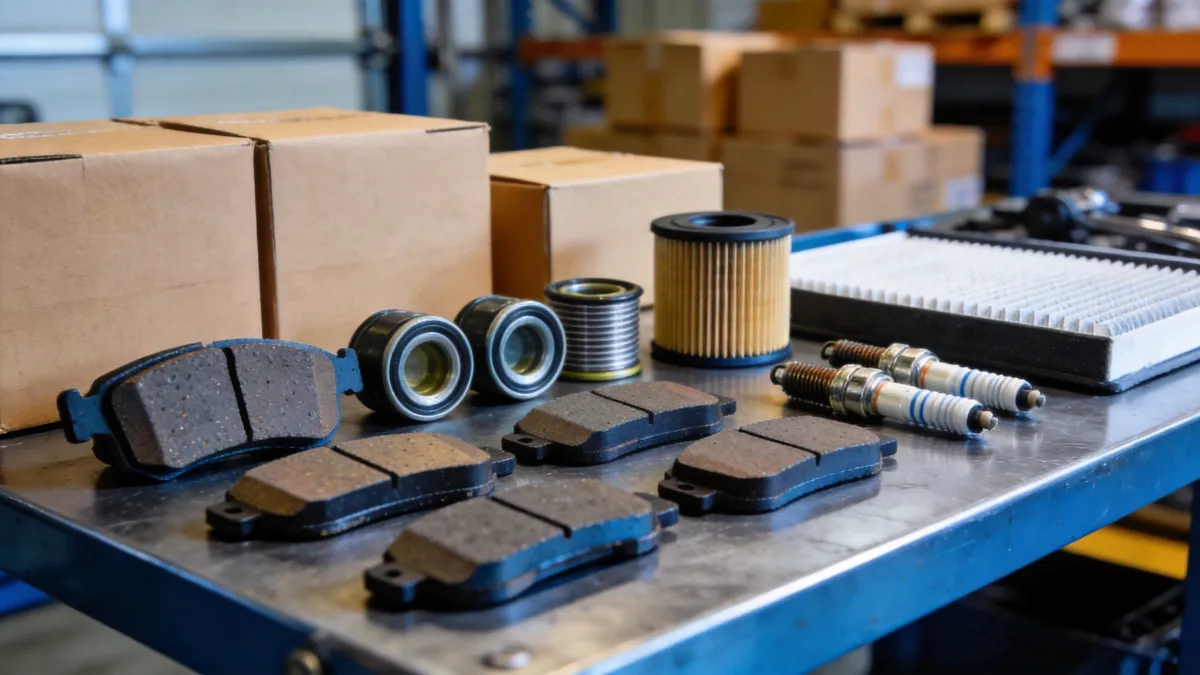
The direct answer: they combine non-stop repeat demand, low factory prices and limited commercial risk compared with any other parts category. Fast-moving parts are the consumables every driver replaces on a schedule — brake pads, oil, air, fuel and cabin filters, spark plugs, wipers and brake fluid — regardless of what brand they drive.
The numbers confirm the scale. China's General Administration of Customs reports auto-parts exports of USD 95.72 billion in 2025, up 2.5% year on year, keeping China the world's largest supplier of the category. On the demand side, Ken Research sizes the GCC aftermarket at roughly USD 10.69 billion in 2025, heading toward USD 15.32 billion by 2032 at a 5.3% CAGR, driven by a vehicle parc expanding from 19.7 million to about 24.56 million vehicles.
From our daily work at Keerki Limited with brake and filter factories in Guangzhou and Wenzhou, we see reorder cycles of 45–60 days from the same buyers in this category, while body panels and crash parts are ordered once or twice a year. Repetition is what builds a stable trading business — and that is exactly why this category is the smartest first step for a new importer.
Which Parts Rotate Fastest in Gulf Markets?
Brake pads rotate fastest in Gulf markets, followed by oil, air and cabin filters, then spark plugs and wiper blades — a result of extreme heat and city driving. The table summarizes replacement cycles and indicative Chinese factory (FOB) price ranges:
| Part | Typical replacement cycle | Indicative FOB factory price | Typical MOQ |
|---|---|---|---|
| Ceramic brake pad set | 30,000–50,000 km | USD 2–6 per set | 50–100 sets |
| Oil filter | 5,000–10,000 km | USD 0.6–1.5 per piece | 500–1,000 pieces |
| Air filter | 10,000–20,000 km | USD 0.8–2 per piece | 300–500 pieces |
| Cabin filter | 10,000–15,000 km | USD 0.7–1.8 per piece | 300–500 pieces |
| Spark plug | 30,000–100,000 km by type | USD 0.5–2.5 per piece | 1,000–2,000 pieces |
| Wiper blade | 6–12 months | USD 0.5–1.5 per piece | 500–1,000 pieces |
These ranges come from live listings on Chinese B2B platforms. Wenzhou-based factories, for example, currently advertise front and rear ceramic brake pad sets at USD 2.12–5.86 per set with minimum orders starting at 10–50 sets on Made-in-China. Prices move with raw materials, order volume and packaging, so treat them as a negotiating range rather than a final quote.
What Does a Shipment of Fast-Moving Parts Really Cost Landed?
Your landed cost is the factory price plus sea freight, insurance, customs duty, conformity certificates, clearance and inland transport — and the product itself usually represents only 60–70% of that total. The most common first-timer mistake is calculating margins on the FOB price alone.
| Cost component | Approx. share of landed cost | Practical notes |
|---|---|---|
| Product price (FOB) | 60–70% | Negotiable with volume and payment terms |
| Sea freight & insurance | 8–15% | Brake pads are dense and heavy — weight matters |
| Customs duty & VAT | 5–20% | Depends on country and HS classification |
| Conformity & inspection | 1–3% | SABER fees for Saudi Arabia, assessment-body charges |
| Clearance & inland delivery | 3–6% | Broker fees, storage, last-mile transport |
On timing, sea freight from South China ports (Guangzhou, Shenzhen) to Jeddah Islamic Port typically takes 16–22 days port-to-port for full containers, and 18–26 days to King Abdulaziz Port in Dammam, based on current 2026 carrier schedules. Add 1–3 days for customs clearance and 5–10 days for SABER certification if documents are not prepared in advance, and a realistic plan for your first shipment is 30–45 days from order confirmation to warehouse delivery.
What Are the SABER and SASO Requirements for Auto Parts?
The direct answer: importing auto parts into Saudi Arabia requires a Product Certificate of Conformity (PCoC) and a Shipment Certificate of Conformity (SCoC) issued through the SABER platform, under the Technical Regulation for Auto Spare Parts published by the Saudi Standards, Metrology and Quality Organization (SASO). Article 6 of the official technical regulation states that the supplier must obtain a certificate of conformity from a SASO-notified assessment body following the Type 1a type-approval model for original parts, with parallel requirements for replacement (aftermarket) parts.
In practice, this means locking down three points with your Chinese factory before any payment:
- Valid test reports from an accredited laboratory for regulated parts — brake linings top that list, covered by standards such as SASO ISO 6310 and 6312.
- Label and packaging compliance: country of origin, part number, manufacturer details, and no original-brand logos on replacement parts.
- The factory's ability to supply the technical file needed to register the product on SABER under your importer account.
The UAE, Kuwait and other Gulf states differ in the details, but the general rule is the same: safety-related parts (brakes, suspension, steering) always face the tightest scrutiny. Never build your import plan around a supplier who cannot produce a complete technical file for the product.
Practical Steps to Import Your First Fast-Moving Parts Shipment
The following sequence mirrors the process we run at Keerki with Gulf traders building their first order:
- Build your assortment from the local vehicle parc: list the 10 most common models in your market (in Saudi Arabia, Japanese and Korean models still lead while Chinese brands grow fast) and map the matching OE part numbers.
- Request quotes from 5–8 specialized factories, not general trading companies, and compare them on identical specifications and packaging. A good starting point is the Keerki auto-parts supplier directory, which indexes thousands of classified factories.
- Order physical samples and test them in a local workshop or lab — weight, dimensions, friction material — against the original part before committing to volume.
- Verify the technical file and factory credentials: test reports, ISO 9001 or IATF 16949 certification for larger plants, and a track record of exporting to the Gulf or Africa.
- Start with an LCL consolidation or a 20-foot container spread across 20–40 fast-moving SKUs, instead of betting all your capital on two or three references.
- Run a pre-shipment inspection on a random carton sample (AQL 2.5 is a common standard) and verify part numbers and packaging against your purchase order.
- Prepare your SABER file early: register products at least two weeks before vessel arrival to avoid port demurrage.
Where Do You Find Brake and Filter Suppliers — and How Do You Verify Them?
Chinese brake manufacturing concentrates in Shandong, Hebei and Zhejiang (especially Wenzhou), while filter production clusters in Hebei's Qinghe county, Zhejiang and Guangdong. Knowing this industrial map saves you weeks: the simple question "which city is your factory in?" reveals a lot about a supplier's real specialization.
Three sourcing channels work in practice: Chinese B2B platforms for scanning and pricing; trade shows for meeting factories face to face — the nearest major one being Automechanika Dubai on 10–12 November 2026, whose latest edition drew 2,273 exhibitors from 63 countries and over 50,408 visitors according to organizer Messe Frankfurt, trackable via the Keerki exhibitions calendar; and representation offices inside China that negotiate and inspect for you. You can also shortlist from the factories recommended by Keerki to start with pre-vetted suppliers.
A tip from Keerki: never buy the "cheapest brake pad" on the market. Brakes are a safety component, and one defective container can cost you your reputation in the entire market. Our working rule: choose the factory with the highest share of exports to regulated markets (the Gulf, Europe, South America), not the one with the lowest price, and always demand a recent test report for the exact part number you are buying — not for a "similar" product. A 10–15% price premium buys you safety that is worth every dollar.
Frequently Asked Questions
How do I import auto parts from China for the first time?
Start by defining a fast-moving assortment matched to the most common models in your market, then request quotes from 5–8 specialized factories and order samples first. After approving samples, place a small first order (LCL or a 20-foot container) with pre-shipment inspection, and complete conformity requirements such as SABER for Saudi Arabia.
How much do brake pads cost from China?
Chinese factory prices for ceramic brake pad sets range from about USD 2 to USD 6 per set on FOB terms with minimum orders of 50–100 sets, based on listings visible on Chinese B2B platforms in October 2026. The final price depends on quantity, friction material (ceramic or semi-metallic), packaging and payment terms.
Are Chinese auto parts good quality?
Quality spans a wide spectrum — from plants supplying global brands under IATF 16949 systems to small workshops with no quality control at all — so there is no single answer. The practical standard is to pick a factory with valid test reports and export history to regulated markets, backed by an independent pre-shipment inspection; done this way, you get acceptable quality at a fraction of genuine-part prices.
Do I need SABER certification to import brakes and filters into Saudi Arabia?
Yes. Auto parts covered by the Saudi technical regulation require both product and shipment certificates through SABER before customs clearance. Brake linings are explicitly regulated under standards such as SASO ISO 6310 and 6312, so confirm the factory holds valid test reports before signing.
How long does shipping auto parts from China to the Gulf take?
Sea freight from South China ports to Jeddah typically takes 16–22 days port-to-port, and 18–26 days to Dammam, based on current 2026 sailing schedules. Including customs clearance and SABER procedures, plan for a total of 30–45 days from order confirmation to warehouse receipt.
Which Chinese city is best for buying auto parts?
Guangzhou leads as a trading hub thanks to its wholesale markets and proximity to export ports, while Wenzhou and Shandong specialize in brakes, Qinghe county in Hebei dominates filters, and other Zhejiang cities cover additional components. Combining a factory tour with the Guangzhou markets gives the broadest part-number coverage.
Conclusion
Fast-moving parts are the smartest entry point into the auto-parts trade from China: repeat demand backed by a Gulf market growing from USD 10.69 billion to USD 15.32 billion between 2025 and 2032, factory prices starting at a few dollars per set, and a supply chain that shipped USD 95.72 billion of parts last year. The formula is simple but demands discipline: an assortment built on your vehicle parc, a real factory rather than a trader, inspection before shipment, and early conformity paperwork.
Keerki Limited is a China-based sourcing and commercial representation company headquartered in Guangzhou, helping businesses in the Gulf and the Arab world import from China safely for over 10 years. We handle brake and filter factory search and verification, price negotiation, pre-shipment quality inspection, and shipping and customs — so your goods arrive at the lowest realistic cost with no surprises. Start today through our service request form or message us on WhatsApp +86 133 9212 7362, and explore the full range of Keerki services.