- Gulf food packaging demand is accelerating: the UAE targets growing the food and beverage sector's GDP contribution from AED 30 billion to AED 40 billion by 2028.
- China is the world's largest packaging source; its plastic products exports alone hit RMB 134 billion in early 2026, up 23% per China Customs.
- Importing food-contact packaging into Saudi Arabia needs a lab test certificate with every consignment plus the food-contact symbol, per SFDA rules.
- The Drewry World Container Index stood at $4,389 per 40ft container on 5 November 2026, with congestion in China easing.
- Sino-Pack 2026 in Guangzhou (4–6 March) is the best annual venue to meet Chinese packaging factories face to face.
Gulfood Manufacturing 2026 was held in Dubai on 3–5 November 2026, with packaging at the center of the conversation, while the UAE confirmed its target of growing the food and beverage sector's GDP contribution from AED 30 billion to AED 40 billion by 2028. For Gulf traders the signal is clear: demand for food packaging will keep climbing, and the question is where to source it at the right price with full compliance. This guide answers, step by step, from inside the Chinese market.
Why is Gulf demand for food packaging accelerating in 2026?
Three forces are converging: a growing regional food and beverage sector, the rapid expansion of delivery platforms and cloud kitchens, and tighter rules on food-contact materials. According to Arab News coverage of Gulfood Manufacturing 2026, the UAE is investing heavily in national food security, lifting packaging demand across the region.
The numbers back the trend. Market researchers estimate the GCC packaging machinery market at USD 1,393.51 million in 2025, growing at a 4.86% CAGR — the fastest in the region — driven by food security programs and localization of food manufacturing. The Middle East and Africa are also projected to be the fastest-growing region in packaging printing, at an 8.1% CAGR between 2026 and 2034, within a global market heading toward $901 billion by 2034.
Globally, the food containers market is forecast to expand from USD 328.56 billion in 2025 to roughly USD 648.56 billion by 2034, a 9.3% CAGR, with Gulf countries posting notable growth thanks to fast-food consumption and government pushes for sustainable packaging. For importers, the takeaway is simple: those who lock in a stable supply channel today will hold a cost advantage that latecomers will struggle to match.
Which types of food packaging do Gulf importers buy from China?
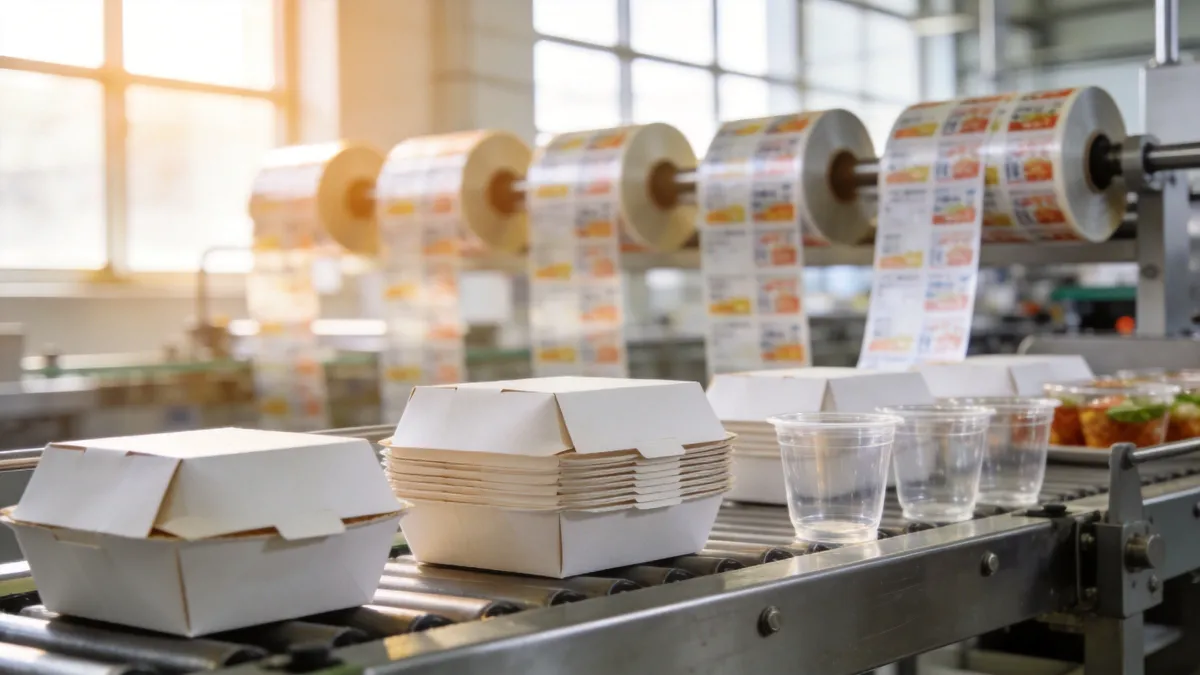
The most ordered categories are food-grade plastics (PET and PP), followed by paper and kraft formats, aluminium containers, and eco-friendly bagasse products. The table below summarizes the main categories and importing notes:
| Type | Common uses | Importing notes |
|---|---|---|
| Clear PET cups and lids | Cold drinks, juices, desserts | Lightweight; requires food-contact certification; sensitive to heat during summer shipping |
| Microwavable PP containers | Restaurants, ready meals, delivery | The most in-demand category in the Gulf; verify heat resistance and lab certification |
| Paper and kraft cups and boxes | Coffee, fast food, bakeries | Check the quality of the inner grease- and liquid-resistant lining |
| Aluminium containers and trays | Restaurants, airlines, catering | Thickness and weight tolerances matter; small deviations change unit cost |
| Eco-friendly bagasse containers | Premium restaurants, sustainability-focused markets | Higher price point; verify the biodegradability certifications required in the Gulf |
| Printed flexible films and pouches | Confectionery, dates, nuts, coffee | Custom printing raises the MOQ; request printing cylinders in your name |
A practical tip: start with two or three fast movers — ready-meal containers and paper coffee cups, for example — then expand after running the full import cycle from factory floor to warehouse once.
Where are China's food packaging factories concentrated?
Chinese packaging manufacturing clusters in three regions: Wenzhou and Longgang in Zhejiang (printing, paper and plastic packaging), Guangdong — especially Chaozhou and Shantou for flexible printed formats — and Jiangsu and Shandong for high-volume containers.
A live example from Wenzhou: packaging specialist Baofeng, focused on aviation catering formats, has developed paper meal boxes that withstand flight ovens above 200°C and runs a traceability system linking every cup to its production line, worker and paper roll, according to a China.org.cn report on 5 November 2026. Quality can match your requirements — provided you know how to select and verify the factory.
If you want to see the entire sector under one roof, Sino-Pack 2026, together with the PACKINNO packaging products fair, takes place in Guangzhou from 4 to 6 March 2026 at the Canton Fair Complex — the most important annual date on China's packaging calendar. Track this and other shows on our China exhibitions page, and shortlist factories early through our supplier directory of more than 35,000 suppliers.
What are the import requirements for food-contact packaging in Saudi Arabia and the Gulf?
The core rule: any material that touches food directly — cups, trays, wraps, cutlery — falls under Saudi Food and Drug Authority (SFDA) requirements and largely harmonized Gulf regulations. According to the official SFDA announcement, every consignment must carry a laboratory test certificate from an authorized laboratory, attested and valid for one year unless the composition changes, and plastic packaging must bear the food-contact safe symbol.
Gulf standards add further layers, per the SFDA's guidance: GSO 839 for general food package requirements, GSO 1863 for plastic packages, and GSO 9, which mandates labeling in Arabic or Arabic plus an identical second language. The Saudi technical regulation for food-contact tools adds: the recycling symbol on plastics, the biodegradable logo where applicable, traceability via QR code, and strict heavy-metal limits.
| Requirement | Authority / reference | What the importer must do |
|---|---|---|
| Lab test certificate per consignment | SFDA | Request it from the factory before shipping; verify the lab's accreditation and validity date |
| Food-contact safe symbol | SFDA | Ensure it is printed on the container itself, not only the outer carton |
| Arabic labeling | GSO 9 | Prepare the Arabic artwork early and send it to the factory before printing |
| Recycling symbol and biodegradable logo | SASO technical regulation | Confirm symbols match the actual material used |
| QR-code traceability | SASO technical regulation | Agree on traceability data with the factory at purchase-order stage |
| Chemical migration limits | SFDA / GSO | Test samples from each production batch, not just the initial sample |
How much does shipping from China to the Gulf cost in November 2026?
The Drewry World Container Index (WCI) stood at $4,389 per 40ft container in the 5 November 2026 assessment, down 1% week on week but still 124% above a year earlier, per Drewry's weekly report. The good news: congestion at Chinese ports is easing — average vessel waiting time in Shanghai improved to 35 hours — and the return of Suez Canal transits (60% of Asia–Europe capacity) is releasing capacity that pushes rates down.
On the Gulf lane specifically, Drewry's intra-Asia commentary noted Shanghai–Jebel Ali rates remained elevated at around $8,584 per 40ft container in week 43. Packaging is a lightweight, high-volume commodity, so a 40ft high-cube container is usually the most economical choice, and the better you fill it, the lower your unit cost. Consolidating orders from several factories into one container saves you from repeating the higher per-cubic-meter cost of LCL shipments.
Practical steps to import your first food packaging shipment from China
- Define the specification precisely: material (PET, PP, paper), capacity, wall thickness, colors, and the number of print colors — a vague specification is the number one cause of quality disputes.
- Order physical samples and test them locally: run the packaging with your real product — heat, grease, liquids — before committing to any volume.
- Verify the factory, not the trading showroom: industrial license, real production lines, and prior export experience to the Gulf; in Keerki's experience working with packaging factories in Guangzhou, most problems trace back to traders presenting themselves as factories.
- Request the lab certificate before signing: confirm tests were run on the finished material after manufacturing, not on a virgin raw material, and that the laboratory is recognized by Gulf authorities.
- Lock Arabic printing and symbols upfront: label, food-contact symbol, recycling mark, and QR code — correcting these after printing means losing the batch.
- Choose the right Incoterm: FOB gives you control over freight and carrier selection and usually suits repeat importers best.
- Inspect before shipping: an independent pre-shipment inspection sampling from each batch — thickness measurement, print quality, lid fit, and production-line hygiene.
- Prepare complete documentation: lab certificate, commercial invoice, packing list, certificate of origin, and bill of lading — a missing document means delays and storage fees at the port.
A tip from Keerki: the most common mistake we see in Guangzhou is an importer changing the material or adhesive mid-production to save a few cents — which instantly voids the lab certificate tied to the original composition and gets the shipment held at customs. Freeze the composition in the purchase order, and have your inspector match random pre-shipment samples against the approved sample and certificate; it can save you weeks of detention.
Frequently Asked Questions
Does food packaging need a SABER certificate when importing into Saudi Arabia?
Food-contact packaging is governed primarily by SFDA requirements — a lab test certificate per consignment and the food-contact symbol — plus Gulf standards GSO 839 and GSO 1863. Some categories of kitchen tools and utensils fall under technical regulations that require SABER registration, so check the exact classification of your product before shipping to avoid customs holds.
What is the typical minimum order quantity (MOQ) at Chinese packaging factories?
The MOQ varies with the material and the printing: plain standard items accept far smaller quantities than custom-printed ones, because custom printing requires dedicated cylinders and setup. As a rule of thumb, the more customization you add, the higher the MOQ — and negotiating staggered deliveries usually works better than negotiating the quantity itself down.
Can Chinese factories print my brand in Arabic?
Yes, most major packaging factories routinely print Arabic for Gulf markets, but calligraphy quality and right-to-left layout need careful review. Send final print-ready artwork files, request a digital or physical print proof before full production, and verify the mandatory food-contact symbol and recycling marks within the design itself.
What is the difference between importing biodegradable and conventional plastic packaging?
Biodegradable formats such as bagasse or PLA require additional certifications proving their degradability under recognized standards, and in Saudi Arabia they must carry the biodegradable plastic logo under the technical regulation. They cost more than conventional plastics, but demand is rising as Gulf restaurants and cafés move toward sustainability.
Is sea or air freight better for packaging materials?
Sea freight is the only viable option for packaging: it is a lightweight, bulky, relatively low-value commodity, and air freight destroys the margin except in emergencies. Plan inventory ahead of peak seasons such as Ramadan, and use periods of softer rates to stock up.
How can I be sure a container is genuinely food-contact safe?
The only reliable proof is a test certificate from an accredited laboratory, issued for the finished material after manufacturing, covering the migration limits required by the SFDA. Do not rely on a "Food Grade" stamp on the carton alone, and verify the actual composition matches the certified one.
Conclusion
The Gulf food packaging market is growing steadily on the back of food security programs and a booming restaurant and delivery scene — and China remains the source best able to combine price, customization, and volume. Success depends on three things: a real, verified factory; alignment with SFDA requirements from the design stage; and an independent inspection before the container is sealed.
Keerki Limited is a China-based sourcing and commercial representation company headquartered in Guangzhou, helping businesses in the Gulf and the Arab world import from China safely for over 10 years — through factory verification, negotiation, pre-shipment inspection, consolidation, shipping, and customs clearance: exactly the steps that turn a packaging shipment from a risk into shelf-ready stock. Explore our services, start with a service request, or message us on WhatsApp at +86 133 9212 7362.