- China exported 167,962 tractors between January and October 2026, 11.7% more than a year earlier, and the value of those shipments rose 16.8% to RMB 8.56 billion.
- Value is growing faster than volume, so the average machine leaving a Chinese port is larger and better equipped than the one that left in 2025.
- The certificate file decides clearance more often than the price: a Product Conformity Certificate and a Shipment Certificate in Saudi Arabia, a GOEIC factory entry in Egypt.
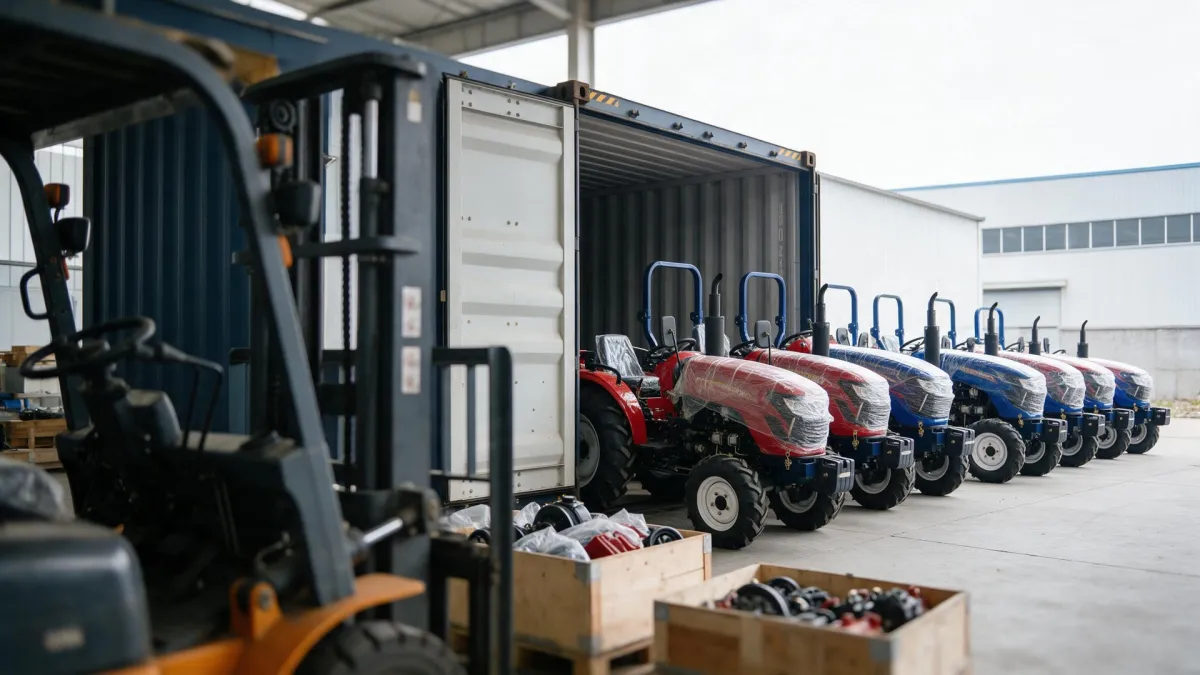
- A 40-foot high cube offers 76 m³ and up to 28.62 tonnes of payload, so two or three compact tractors per box is normal and the loading plan matters as much as the freight rate.
Farm machinery is one of the few Chinese export categories where volumes and unit values are climbing together. That changes the conversation in a buyer's office: not which factory will shave fifty dollars off a quotation, but which supplier can hand over a machine, a certificate file and a parts list that all survive the port.
The trade data for January to October 2026 makes the point. Chinese factories exported 167,962 tractors in those ten months, 11.7% more than in the same period of 2025, and the value of those exports reached RMB 8.56 billion, up 16.8% (General Administration of Customs of China). Value grew five percentage points faster than volume, so the average machine is bigger and better equipped than the one that left the year before.
What the 2026 export numbers actually say
October shows the same shift from another angle. Exporters shipped 14,571 tractors that month, 0.8% fewer than in October 2025, yet the value of those units rose 12.2% to RMB 753.92 million. Fewer machines, more money per machine: the mix has moved towards cabbed units, air conditioning and implements sold with the tractor rather than after it.
The wider farm machinery basket, which adds ploughs, seeders, sprayers, harvesters and parts to the tractor line, reached RMB 58.69 billion in January to October 2026, 7.5% higher year on year, with October alone at RMB 4.59 billion, up 12%. Every tractor sold in 2025 creates a parts order in 2026.
For an importer in Riyadh, Cairo or Baghdad the reading is direct: factories that spent 2026 filling orders for better-equipped machines have little appetite for bare-specification bargaining, and slots for the first quarter of 2027 are being committed against those orders.
Which machines Arab buyers actually order
Most containers leaving Ningbo, Shanghai and Qingdao for Gulf and North African ports carry one of five things. Each fails at a different moment: at the factory gate, at the certificate desk, or in the third season of use.
| Machine class | Where it earns money | Inspect before the deposit | Loading note |
|---|---|---|---|
| Compact utility tractor | Orchards, smallholdings, water pumping | Power take-off rating, hydraulic flow, roll-bar height | Travels upright; two or three per 40-foot box |
| Row-crop tractor | Cereals, vegetables, fodder | Gearbox type, final drive, tyre width, ballast | The widest tyre set decides how many fit |
| Mini combine harvester | Rice, wheat, sesame | Sieve and concave setting for the crop | Often shipped with the header detached |
| Implements and trailers | Work attached to the tractor | Steel thickness, welding, paint preparation | Knocked down; fills gaps around the tractors |
| Spare-parts kit | First service year of the fleet | Part numbers matched to engine and chassis plates | The cheapest cubic metres in the box |
Three questions separate a usable quotation from a decorative one. What is the rated power at the power take-off rather than at the flywheel? Which gearbox and final drive does the factory actually fit on this model? Are the tyres, ballast and hydraulic outlets the same ones the machine is homologated with? A quotation that answers none of them is a price, not an offer.
Buyers who work through a sourcing partner see those questions asked before a factory is shortlisted, which is why the specification sheet matters more than the factory list. Our supplier directory and China sourcing guide follow that sequence.
The paperwork that decides whether the container clears
Saudi Arabia is where paperwork most often explains why a container sits. Machinery falls under the SASO technical regulations, and the route runs through the SABER platform: a Product Conformity Certificate, then a Shipment Certificate for each consignment. The chain is sequential: no product certificate, no shipment certificate, no clearance. Since 1 January 2026 applications use the current twelve-digit Saudi tariff code, and Arabic labelling and manuals belong in the file from the start (SASO, SABER).
Egypt runs a different gate. Foreign factories exporting regulated goods must be entered in the GOEIC register of qualified factories, under Decree 43 of 2016 as amended by Decree 195 of 2022. Registration is decided within fifteen days of a complete file, and documents carrying an expiry date must be renewed within thirty days of that date; the file itself has to be certified by a chamber of commerce and by the Egyptian embassy in the country of origin (GOEIC). A factory outside the register cannot ship, whatever its price list says.
Elsewhere in the Gulf the pattern repeats with local variations. GSO standards feed the national schemes of the UAE, Kuwait, Qatar, Oman and Bahrain, and restricted items need a permit from the customs authority before arrival, which in Saudi Arabia means ZATCA.
| Market | Platform or body | Document before the vessel berths | Practical note |
|---|---|---|---|
| Saudi Arabia | SASO through SABER | Product Conformity Certificate, then Shipment Certificate | Twelve-digit tariff code; Arabic label and manual |
| Egypt | GOEIC | Entry in the register of qualified factories | Chamber of commerce and embassy certification |
| United Arab Emirates | MoIAT with ESMA standards | Product registration or conformity certificate where required | Emirate-level customs formalities sit on top |
| Kuwait, Qatar, Oman, Bahrain | GSO standards, national customs | Conformity certificate and, where relevant, an import permit | Requirements differ by category; ask before booking |
Container maths before the price negotiation
Farm machinery is bulky and light, so the box fills before the weight limit arrives. A 40-foot high cube gives about 12.03 metres of internal length, 2.35 metres of width and 2.70 metres of height, roughly 76 m³, with a maximum payload of 28.62 tonnes and a door opening of 2.34 by 2.58 metres (carrier-published container specifications). Those numbers decide the quote more than the freight rate does.
Take a compact tractor with an overall length of 3.9 metres and a folded roll-bar at 2.4 metres. Three units fit in a row with 0.3 metres left for lashing, and the fourth position is lost to the door recess. Add a cabbed unit standing 2.9 metres tall and the door height becomes the binding constraint: the roof travels separately, or the machine goes on a flat rack and the freight doubles. A factory that has loaded tractors before sends a loading plan with the quotation; one that has not sends photographs of a machine in a warehouse.
Port capacity is not the constraint it was. Ningbo-Zhoushan passed 40 million TEU on 10 November 2026 for the second year running, with more than 310 routes to over 700 ports (People's Daily). Rates are a different story. The Shanghai Containerized Freight Index stood at 3,503.78 on 20 November 2026, down 1.92% week on week, while the China to Middle East lane rose 1.32% to USD 6,670 per TEU, its third consecutive weekly gain (Shanghai Shipping Exchange). A falling global index with a rising Gulf lane is the clearest argument for a freight validity date in writing next to the machine price.
Spare parts: the line item buyers underestimate
A tractor that works one season and then waits eleven weeks for a hydraulic hose has cost more than the gap between two quotations. The parts conversation belongs in the first email. Ask for the parts manual with exploded diagrams and part numbers, the consumables list for the first service year, and photographs of the engine and chassis plates.
In our work with Arab importers, the shipments that age well share one habit: a parts kit ordered with the machines and sized to the fleet. Filters, belts, seals, brake linings and injector nozzles cost a fraction of an air-freighted emergency and arrive before the first failure.
From enquiry to cleared container: eight steps
- Define the job, not the model. Hectares, crop, soil and operator decide the class before a brand name does.
- Send one specification sheet to three factories. Identical fields and units, so answers can be compared line by line.
- Verify the factory, not the trading company. Business licence, export licence and a video call on the assembly line beat a catalogue.
- Request the certificate file before the deposit. Test reports, the route the factory used before, and who pays for the shipment certificate.
- Confirm the tariff classification in writing. Twelve digits in Saudi Arabia, the national code elsewhere, agreed by factory, broker and conformity body.
- Fix the loading plan and packing list. Unit dimensions, detached parts, lashing points, and spare parts packed where they can be found.
- Insure and document. Marine cargo cover for the full CIF value, plus photographs before the doors close.
- Clear, then register. Keep certificate numbers, invoice, packing list and parts manual together; the second shipment is easier.
Keerki tip: print the Arabic label and manual at the factory, not at the destination. A label applied after arrival is a label your conformity body has not seen, and the cheapest place to change a specification is the assembly line.
Frequently asked questions
How long does a farm machinery order from China take?
For a standard model in stock, two to three weeks to load; for a built-to-order tractor, six to ten weeks from deposit to loading, plus four to six weeks at sea to Gulf ports. Chinese New Year moves every other date, so orders for the first quarter of 2027 are best placed before the factories close.
Will a Chinese tractor pass Saudi conformity requirements?
Machines from established Chinese factories pass routinely when the file is complete: test reports from an accepted laboratory, a quality management certificate, Arabic labelling and the correct twelve-digit tariff code. The risk sits in the file, not in the factory's nationality. Confirm the applicable regulation with a conformity body before paying a deposit.
Can I import a used tractor into Arab markets?
Most Gulf and North African markets restrict or condition the import of used machinery, and the rules differ by country and by age of the machine. Treat a used unit as a separate project with its own approval route and confirm the position in writing with your customs broker before you buy.
What is the cheapest way to ship two tractors?
Two compact units usually travel in one 40-foot high cube, with implements and parts packed around them. Sharing a container is cheaper per unit but complicates the certificate file. Compare landed cost, not the freight line.
Which documents should I keep for the spare-parts order?
Keep the parts manual with exploded diagrams, photographs of the engine and chassis plates, the original packing list and the part numbers as invoiced. Those four items let any dealer identify a filter, a seal or an injector without opening the machine.
Chinese farm machinery in 2026 is a market of rising specification and rising value, not a bargain bin. The buyers who do well treat the machine, the certificate file and the parts kit as one purchase, and put the loading plan and the freight validity in writing before the deposit leaves the bank.
Keerki Limited has worked in China sourcing for more than ten years, with offices in Hong Kong, Guangzhou and Makkah, and has served hundreds of Arab importers across machinery, automotive and consumer goods. If you are comparing farm machinery suppliers for the 2027 season, the team can help you build the specification sheet, verify the factory and assemble the certificate file before anything is crated. Send your requirement through keerki.com/request or on WhatsApp +86 133 9212 7362.