- Saudi Arabia released the Round 8 request for qualification on 11 November 2026: 3,200 MW in total, of which 1,900 MW is solar.
- Two days earlier ACWA Power, Badeel and SAPCO closed financing on 15 GW of solar and wind at a total investment value of USD 8.2 billion.
- One 40-foot high cube holds 600 to 720 modules of 550 W and lands in Riyadh at about USD 0.165 to 0.170 per watt.
- Duty on HS 8541.43 is 0%, so VAT at 15% of CIF is the biggest border line at roughly USD 7,000 per container.
- SASO Circular 247 requires the importer's name and CR number on the label since 1 October 2026; without it no shipment certificate is issued.
Saudi Arabia opened qualification for its eighth renewable round on 11 November 2026 with 1,900 MW of solar inside a 3,200 MW package, in the same week that a 15 GW portfolio reached financial close. Module demand into the Kingdom is no longer a forecast.
The useful question is narrower: what does one container of panels cost by the time it leaves Jeddah, and which document stops it when something is wrong. Every figure below comes from a price or rule published between 24 September and 12 November 2026.
What changed in the Saudi solar market in November 2026?
Saudi Arabia added 1,900 MW of solar to its procurement pipeline on 11 November 2026 and closed financing on 12 GW of solar two days earlier. The Saudi Power Procurement Company, principal buyer under the National Renewable Energy Programme, released the Round 8 request for qualification for Tumair at 900 MW in Riyadh province, East Al-Amoah at 1,000 MW in Aseer province, and a 1,300 MW wind project at Al-Mozeraah in Makkah province.
The financing news was larger. ACWA Power with Badeel, a PIF company, and SAPCO, an Aramco subsidiary, closed seven giga-scale plants totalling 15 GW: five solar projects at Bisha, Humaij, Khulis, Afif 1 and Afif 2 for 12 GW, and two wind farms for 3 GW. Total investment is USD 8.2 billion against USD 5.9 billion of senior debt, with operation between the second half of 2027 and the first half of 2028. KAPSARC already counts 19.3 GW operating against a pipeline of 63.8 GW in 53 projects.
The signal for an importer is not that tenders will buy your modules, but that 1,900 MW creates a service market: rooftops, mounting, cable, storage and spares.
What does a solar panel from China cost in November 2026?
A mainstream 182 mm TOPCon module was quoted at an average of RMB 0.70 per watt in China on 11 November 2026, and SMM assessed the Chinese TOPCon module price at USD 0.105 per watt on 5 November 2026. Both readings have been flat for weeks rather than falling.
The upstream line explains why. An M10L TOPCon cell was quoted at RMB 0.29/W the same day, so the cell alone is about 41% of the module price, with leading makers at RMB 0.70 to 0.72/W and second-tier makers near RMB 0.68/W.
| Benchmark, 5 to 11 November 2026 | Price | Source |
|---|---|---|
| 182 mm TOPCon module, China average | RMB 0.70/W (high 0.75) | TrendForce, 11 November 2026 |
| 210 mm HJT module, China average | RMB 0.70/W (high 0.80) | TrendForce, 11 November 2026 |
| M10L TOPCon cell | RMB 0.29/W | TrendForce, 11 November 2026 |
| TOPCon module, China price assessment | USD 0.105/W | SMM, 5 November 2026 |
| TOPCon module, FOB China at the August close | USD 0.108 to 0.114/W | EFANDA, 24 September 2026 |
Two cautions. The renminbi figures are domestic ex-works prices, while an export quote carries certification, packing, haulage and margin. And the module is not the system: rails, clamps, cable and the inverter are priced separately, and on a rooftop the accessories can cost as much as the panels. Our supplier directory groups factories by category.
What does a container of panels really cost to land in Jeddah?
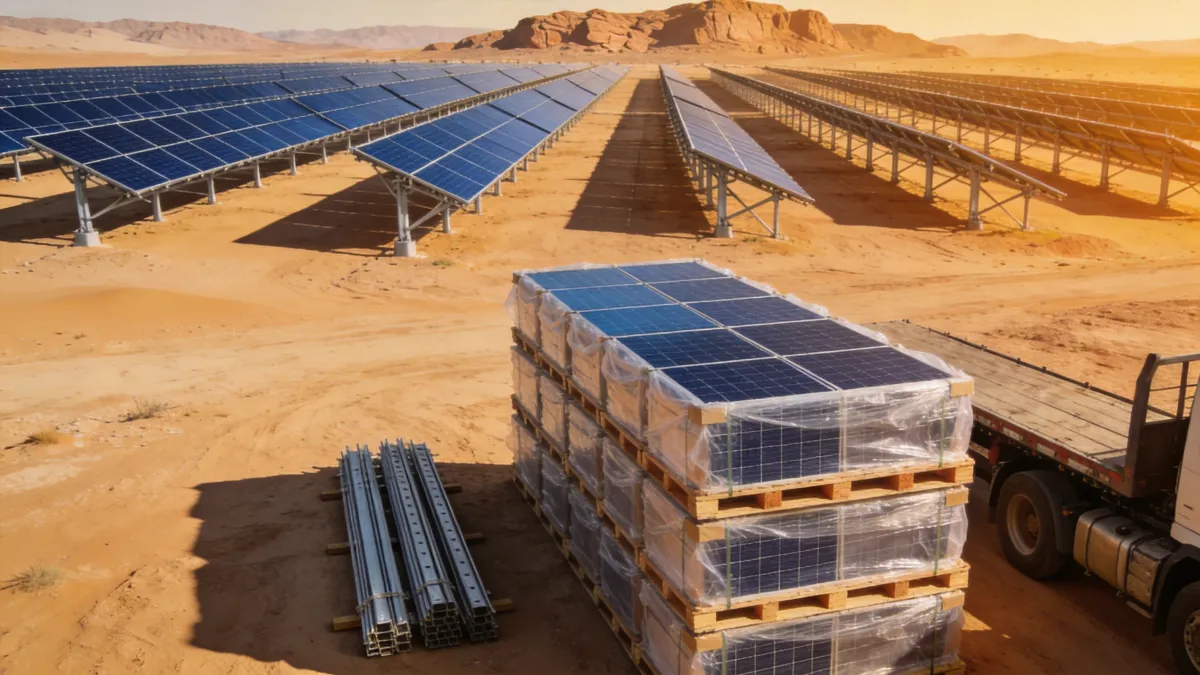
One 40-foot high cube of 550 W modules lands in Riyadh at about USD 0.165 to 0.170 per watt in November 2026, and the panels are only about two thirds of that. A 40HQ carries 600 to 720 modules of 550 W, roughly 330 to 400 kW, on 18 to 20 pallets, so the worked example uses 341,000 W.
Ocean freight for a 40-foot container to Saudi Arabia was quoted at USD 8,500 to 10,120 in November 2026, down 11.3% from October, at 14 to 20 days port-to-port; with Suez routing and berth time, Jeddah runs 18 to 22 days, Dammam 20 to 24, Yanbu 20 to 25.
| Cost line, one 40HQ of 550 W modules | Low (USD) | High (USD) |
|---|---|---|
| Modules, 620 pieces at USD 0.11/W (341,000 W) | 37,510 | 37,510 |
| Inland trucking and export clearance to a South China port | 550 | 550 |
| Ocean freight, 40-foot container to Jeddah | 8,500 | 10,120 |
| Marine insurance at about 0.4% of cargo value | 150 | 150 |
| CIF subtotal | 46,710 | 48,330 |
| Customs duty, HS 8541.43 at 0% MFN | 0 | 0 |
| VAT, 15% of CIF plus duty | 7,007 | 7,250 |
| SABER certificates, brokerage and handling | 1,350 | 1,350 |
| ZATCA import fee, 0.15% of CIF, capped at SAR 500 | 70 | 72 |
| Inland delivery, Jeddah to Riyadh | 1,100 | 1,100 |
| Total landed cost | 56,237 | 58,102 |
| Landed cost per watt | 0.165 | 0.170 |
Three conclusions follow. Duty is not the problem: modules under HS 8541.43 enter at 0%, so budgeting the usual 5% overstates this container by about USD 2,300. VAT is, at roughly USD 7,000, recoverable only if your Saudi entity is registered and files. And freight moves the landed cost by 3 cents a watt, so quoting before booking is a margin risk.
Why the label and the grid frequency decide whether the container clears
Because since 1 October 2026 a module without the Saudi importer's name and commercial registration number printed on its label cannot obtain a shipment certificate, whatever it cost. SASO Circular 247 extended that rule to ten technical regulations, and photovoltaic systems are among them.
The consequence is sequencing, not paperwork: artwork is locked before mass production, the legal name on the label must match the invoice and the certificate, and the nameplate and manual must be in Arabic or bilingual. Certificates come in two parts — a Product Certificate of Conformity per model at about SAR 575 per SKU, and a Shipment Certificate per consignment at about SAR 350 to 400, issued before arrival. SABER certification takes two to six weeks. Mixed containers need separate lines: modules 8541.43, inverters 8504.40, lithium batteries 8507.60 with IEC 62619 and UN38.3.
Frequency is the trap that appears at commissioning. The Saudi grid runs at 60 Hz, with a normal band of 59.9 to 60.1 Hz under the Saudi Arabian Grid Code, so a 50 Hz inverter from a Chinese catalogue fails the connection test even with a valid certificate. Inverters need SASO IEC 62109-1 and 62109-2, IEC 62920 and SASO IEC 62116 for anti-islanding, and grid access is an approval separate from market access.
Modules, kit, or full EPC: which model fits a Gulf trader?
For a Gulf trader the most defensible model in 2026 is modules plus a matched mounting and inverter kit: the margin sits in the accessories and the technical risk sits in the panel. Selling bare modules puts you against tender prices near RMB 0.70/W with a two-thirds cost base and no room to absorb a rework, a pattern Keerki sees across its Gulf buyer files.
| Model | What you buy from China | Best fit | Main risk |
|---|---|---|---|
| Modules only, FOB | Panels, pallets, export packing | Traders with live SABER files | Thin margin, full certification burden |
| Modules plus mounting kit | Panels, rails, clamps, earthing | Rooftops and carports | Coating class, wind load unverified |
| Kit plus inverter and battery | DC and AC kit, storage | Commercial and industrial | 60 Hz settings, IEC 62109 and 62619 evidence |
| Full EPC package | Design, supply, commissioning | Utility plants | Needs a local partner, long cash cycle |
Eight steps to price a solar import before you pay a deposit
- Fix the product definition. Wattage, cell format, bifacial or monofacial, frame brand, exact IEC editions.
- Get the certificate first. IECEE CB number, full IEC 61215 and IEC 61730 reports, and the laboratory accreditation page.
- Lock the label. Importer legal name, CR number and Arabic text approved in writing before production starts.
- Quote in USD per watt, delivered. Modules, haulage, freight, insurance, VAT and inland delivery, divided by the pallet-list wattage.
- Book space four to five weeks ahead. Pre-holiday windows tighten and the sailing you want is rarely the one you get.
- Declare line by line. Modules, inverters and batteries on separate HS lines, descriptions matching the invoice.
- Verify the inverter for 60 Hz. IEC 62109 report, anti-islanding evidence, firmware region confirmed in writing.
- Inspect before loading. Flash-test reports, electroluminescence images and a pre-shipment inspection cost little against a rejected container.
Tip from Keerki: the solar problem we see most often in our Guangzhou office is not panel quality but a label printed before the buyer sent his CR number. Artwork is cheap to change in week one and impossible after the pallets are wrapped, so the label clause goes into the purchase order itself.
Frequently Asked Questions
How much does it cost to import a container of solar panels to Saudi Arabia?
One 40-foot high cube of 550 W modules landed in Riyadh at about USD 56,200 to 58,100 in November 2026, or USD 0.165 to 0.170 per watt, with panels at roughly two thirds and VAT about USD 7,000.
What is the import duty on solar panels in Saudi Arabia?
Modules under HS 8541.43 enter at a 0% MFN rate, with VAT at 15% on CIF plus duty. A ZATCA import fee of 0.15% of CIF applies, minimum SAR 15, maximum SAR 500.
How many solar panels fit in a 40-foot container?
A 40HQ holds about 600 to 720 modules of 550 W, roughly 330 to 400 kW, on 18 to 20 pallets. Weight is rarely the constraint at 27 to 29 kg per single-glass panel.
Do solar panels need SABER certification for Saudi Arabia?
Yes. A Product Certificate of Conformity per model and a Shipment Certificate per consignment, backed by IEC 61215 and IEC 61730 reports through an IECEE route. Since 1 October 2026 the label must also show the importer's name and CR number.
Why must a solar inverter be 60 Hz in Saudi Arabia?
The grid runs at 60 Hz with a normal band of 59.9 to 60.1 Hz, while Chinese and European inverters are set for 50 Hz. Without the right firmware, IEC 62109 evidence and anti-islanding to SASO IEC 62116, the unit fails the connection test after clearing customs.
How long does shipping take from China to Jeddah?
Port-to-port transit is 14 to 20 days on current schedules and 18 to 22 days to Jeddah once Suez routing and berth time are counted. Add one to three weeks for booking, SABER issuance and clearance.
The Saudi pipeline is large and the module price is flat, so margin in 2027 will come from execution rather than from buying cheaply. A trader who knows the 0% duty line, holds a live certificate and books space before the awards land will keep accounts a cheaper quote cannot serve. The Round 8 notice is on the principal buyer's website, and the applicable standards in the SASO technical regulation for photovoltaic systems.
Keerki Limited is a China-based sourcing and commercial representation company headquartered in Guangzhou, helping businesses in the Gulf and the Arab world import from China safely for over 10 years. Our team works with module, mounting and inverter factories in Guangdong and Zhejiang, checks certificates and label artwork against the invoice before a deposit is paid, and follows the cargo through inspection and booking; see our services and the China city guide.
Send your specification, target wattage and destination port through the service request form or WhatsApp +86 133 9212 7362, and we will return a costed comparison from factories we have visited.