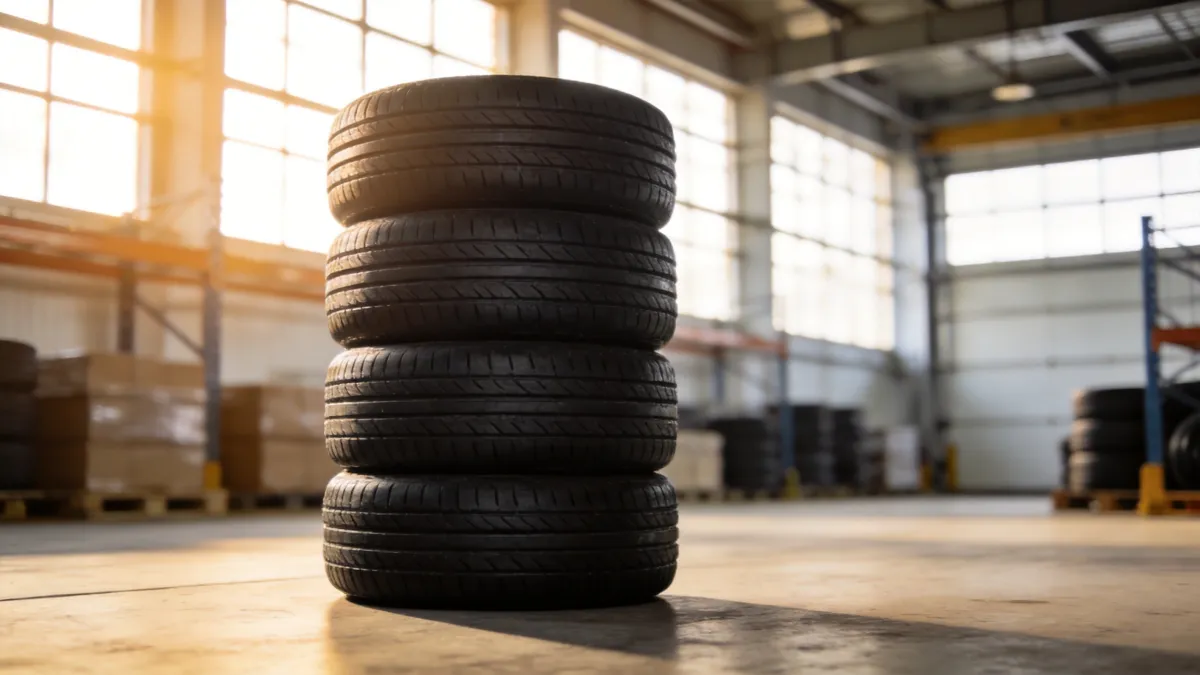
- China exported 362 million new tires in H1 2026, up 3.9% in volume while export value fell — a buyer's market for importers.
- The GCC tire market is worth about USD 9.2 billion and is heading to USD 14.4 billion by 2034, with faster-than-global replacement cycles.
- Saudi Arabia requires Gulf conformity certification, SABER shipment certificates and a SASO tire energy-efficiency label before arrival.
- FOB prices start around USD 8–13 for budget passenger tires and USD 70–143 for truck tires.
- Shandong province (Qingdao, Dongying, Weifang) is the heart of China's tire industry and the right starting point for any serious importer.
If you trade tires in the Gulf — or are thinking about entering this market — the 2026 numbers speak for themselves: Chinese tire exports keep growing in volume while their value declines, and that means one thing: better buying prices for importers. In this practical guide from Keerki Limited we walk you through the whole journey: Gulf market size, real factory prices, SASO and SABER requirements, the Shandong factory map, and a complete execution plan for your first container.
Why Are Chinese Tires a Real Opportunity for Gulf Importers in 2026?
The direct answer: because Gulf tire demand is growing faster than the global average while Chinese supply is getting more price-competitive as volumes rise and values fall.
According to The Report Cubes' GCC tire market report, the Gulf Cooperation Council market was valued at roughly USD 9.22 billion in 2025 and is projected to reach USD 14.43 billion by 2034, a 5.1% compound annual growth rate. What matters most for a trader: extreme heat and long driving distances shorten the tire replacement cycle in the Gulf to 28–32 months versus a 36-month global average, so the replacement (aftermarket) segment regenerates demand unusually fast.
On the Chinese side, the China Rubber Industry Association (CRIA) published customs data for the first half of 2026: rubber tire exports reached 4.94 million tonnes, up 4.9%, while export value slipped 1% to RMB 82.6 billion. In unit terms, China shipped 362.42 million new pneumatic tires (+3.9%), including 66.2 million units in June alone (+9.8%). The same pattern appeared in Q1: 2.35 million tonnes (+5%) worth RMB 39.7 billion (-0.7%), according to SunSirs citing China Customs.
What does "volume up, value down" actually mean? It means Chinese factories are competing aggressively for export orders, and your negotiating power as an importer is stronger today than it was two years ago. People's Daily cited Zhuochuang data showing that in the first four months of 2026, Chinese tire export growth to emerging markets hit 40.3% in Latin America, 38.2% in Africa and 33.4% in Asia — factories are hungry for new markets, and the Gulf sits at the top of their list.
What Does It Really Cost to Import Tires from China?
The direct answer: a budget Chinese passenger tire starts around USD 8–13 FOB, while truck and bus (TBR) tires run USD 70–143, depending on size, brand and order volume.
The figures below come from real factory listings on Made-in-China (October 2026) and give you a realistic negotiating range — remember these are indicative prices that move with natural rubber costs and the yuan exchange rate:
| Category | Use | Indicative FOB Range | Typical MOQ |
|---|---|---|---|
| PCR — passenger car | Sedans and SUVs | USD 8–29 per tire | 50–200 tires |
| LTR — light truck | Pickups and commercial vans | USD 20–50 per tire | 100–200 tires |
| TBR — truck and bus | Heavy haulage 12.00R24, 315/80R22.5 | USD 70–143 per tire | 125–240 tires |
| OTR — off-the-road | Loaders and construction equipment | USD 311–687 per tire | From 10 tires |
But FOB is not the whole story. When calculating your true landed cost per tire, add ocean freight (a 40ft container fits roughly 2,400–2,700 passenger tires or 240–270 large truck tires), insurance, port and clearance charges, customs duty (5% on tires in most GCC states), and VAT. A working rule we use at Keerki: the fully landed cost of an imported tire usually reaches 1.3–1.5 times its FOB price, depending on destination and size.
Transit time matters too: Cogoport's live schedule (30 October 2026) shows Shanghai → Shuwaikh, Kuwait at about 19 days 16 hours, while sailings from Shandong ports to Jeddah typically run 20–28 days depending on routing and transhipment.
Which SASO, SABER and Energy-Label Requirements Apply to Tires?
The direct answer: to enter the Saudi market you need three pillars — a Gulf (GSO) conformity certificate, a SABER certificate of conformity for each shipment, and a SASO tire energy-efficiency label.
Tires are a tightly regulated product category in Saudi Arabia. The official Saudi Standards, Metrology and Quality Organization website (saso.gov.sa) sets out the tire energy-efficiency label requirements: a test report from a SASO-accepted laboratory, a valid Gulf certificate of conformity, a supplier declaration of conformity, product and label images, and the manufacturer's industrial registration. The regulation also requires the foreign applicant to be the actual tire manufacturer — which means you, the Gulf trader, need the Chinese factory's direct cooperation in the registration file.
| Requirement | Authority | Practical Notes |
|---|---|---|
| Gulf conformity certificate (GCC/GSO) | GSO | Prerequisite before SABER registration |
| Shipment certificate of conformity (CoC) | SABER platform | Issued per shipment before arrival |
| Tire energy-efficiency label | SASO | Per model; test reports valid 3 years |
| Labeling | SASO | Arabic or bilingual + production date (week/year) + certificate number |
| Performance testing | Accredited labs | Endurance, wet grip, rolling noise — GSO/ECE standards |
One point many first-time importers miss: the production date on the tire sidewall. Gulf customs scrutinize tire age, and aged stock sitting in some Chinese traders' warehouses can be rejected at inspection. Always demand tires produced within the last six months, and make that a written clause in the contract.
Where Are China's Tire Factories, and How Do You Pick the Right Supplier?
The direct answer: Shandong province — specifically Qingdao, Dongying and Weifang — holds the largest cluster of Chinese tire factories, and correct selection starts with factory verification, not with price.
Shandong is China's "rubber capital": it hosts major groups such as Sailun, which operates 10 production bases across China, Vietnam, Cambodia, Indonesia and Mexico and sells in over 180 countries, and Linglong, which exports to 173 countries and supplies nearly 100 global OEM plants. By the end of 2025, more than 20 Chinese tire companies ran over 30 overseas production bases in 15 countries, including Sailun's Egypt facility with planned capacity of 9 million passenger tires and 1.65 million truck tires after expansions — evidence that Chinese tires have become global players, not just "cheap alternatives".
Still, among thousands of online offers, the gap between a real factory and a trader posing as one is the gap between profit and loss. Practically, verify: the business license and its scope (look for the manufacturing designation), quality certifications (ISO/CCC/ECE/DOT), actual production lines (request a live video tour), and a Gulf export track record with valid GSO certificates. At Keerki, our Guangzhou team visits Shandong factories in person and checks these points before our client pays a single dollar — you can also start from Keerki's recommended factories list or search the auto-parts supplier directory.
Practical Steps to Import Your First Container of Tires from China
The direct answer: start with lab-tested samples, never sign an order before securing the certification path, then inspect the container before it sails — that is the safe sequence.
- Identify the fastest-moving sizes in your market — review your sales or ask local fitting shops; in the Gulf, SUV and light-truck sizes dominate.
- Shortlist 3–5 factories in Shandong and request physical samples in the same size from each for a fair comparison.
- Test the samples in an independent lab (heat resistance and durability come first in the Gulf climate) and check production dates.
- Confirm the factory's SASO readiness: a valid Gulf certificate, recent test reports, and willingness to share its industrial registration.
- Negotiate the contract: FOB price, production freshness (under 6 months), acceptable defect rate (AQL), and a late-delivery penalty clause.
- Run a pre-shipment inspection on the full container: batch numbers, production dates, quantity and size matching.
- Complete SABER before sailing — the shipment certificate must be issued before the goods arrive to avoid storage fines and re-export risk.
If you are entirely new to importing, we recommend reading our earlier guides on importing fast-moving auto parts from China and sourcing Chinese-brand car parts in the Gulf — the verification and inspection principles are nearly identical.
A tip from Keerki: the biggest mistake we see in tire deals is buying "old stock at a tempting price". A Chinese trader offering you a 20% discount? Immediately ask about the production date moulded on the sidewall — a two-year-old tire stored in a hot warehouse has already lost part of its service life, and Gulf customs may reject it outright. At Keerki we check production dates on every batch before shipment, because a cheap tire refused at the port is the most expensive tire you will ever buy.
Frequently Asked Questions
Are Chinese tires good enough for the Gulf market?
Yes, provided you choose the right factory. Major Chinese groups such as Sailun and Linglong supply global car manufacturers and sell in more than 170 countries; quality depends on the product tier and accredited testing, not on the country of manufacture alone.
What is the minimum order for tires from Chinese factories?
It usually ranges from 50 to 200 passenger tires and 125–240 truck tires, depending on size and brand. Many factories accept a mixed trial container with several sizes for a first order.
How long does SASO certification for tires take?
It depends on the factory's readiness: if it already holds a valid Gulf certificate and recent test reports, the process is far simpler, while starting from zero requires full laboratory testing. Begin the certification file in parallel with negotiations, not after signing the contract.
Can I import tires under my own private brand?
Yes, most Shandong factories offer OEM/ODM services with your brand moulded on the sidewall, usually at a higher minimum (often from 20,000 tires for full customization per marketplace listings). Make sure to register your trademark both in your country and in China.
How long is sea freight from China to the Gulf?
From North China ports to Gulf ports it typically takes 19–28 days; for example, Cogoport's schedule shows Shanghai–Shuwaikh (Kuwait) at about 19 days 16 hours, while Jeddah and Dammam take longer depending on routing.
Are there anti-dumping duties on Chinese tires in the Gulf?
As of the preparation of this guide, no anti-dumping duties are in force on Chinese tires in the GCC, and the unified 5% customs duty applies in most member states. Always verify the latest customs updates before contracting, as trade policy can change.
Conclusion: A Growing Market and Competing Supply — Great Timing If You Execute Well
The numbers are clear: a Gulf market heading from USD 9.2 billion to USD 14.4 billion, fast replacement cycles, and Chinese factories competing for orders at lower prices than last year. The opportunity is real for whoever enters methodically: lab-tested samples, early-secured certificates, pre-shipment inspection, and freshly produced stock.
Keerki Limited is a China-based sourcing and commercial representation company headquartered in Guangzhou, helping businesses in the Gulf and the Arab world import from China safely for over 10 years. Our team speaks Arabic, Chinese and English, and handles tire-factory verification, negotiation, pre-shipment quality inspection, and shipping and customs documentation on your behalf — so you can focus on sales and distribution.
Ready to start? Send your request via https://keerki.com/request/ or message us directly on WhatsApp +86 133 9212 7362 and we will reply with a clear plan for your first container of tires.