- TrendForce forecasts PC DRAM contract prices up 13% to 18% quarter-on-quarter in Q4 2026 (reported 30 October 2026), with total DRAM including HBM up 15% to 20%.
- DDR5 lead times stretched from 6 weeks normally to 17 weeks in March 2026 and 50 weeks by August 2026 (Z2 Data); spot DDR5 prices are nearly five times higher than a year ago.
- Root cause: each bit of HBM for AI accelerators consumes roughly three times the wafer capacity of standard DDR5, and Samsung, SK hynix and Micron are effectively sold out of DRAM and HBM through 2027.
- The cost is landing in PCs, servers and graphics products imported from China — but unevenly: consumer NAND channel prices softened in early November 2026 even as DRAM set records.
- Practical advice: lock pricing and volumes for the next two quarters early; most analysts see no real easing before 2027.
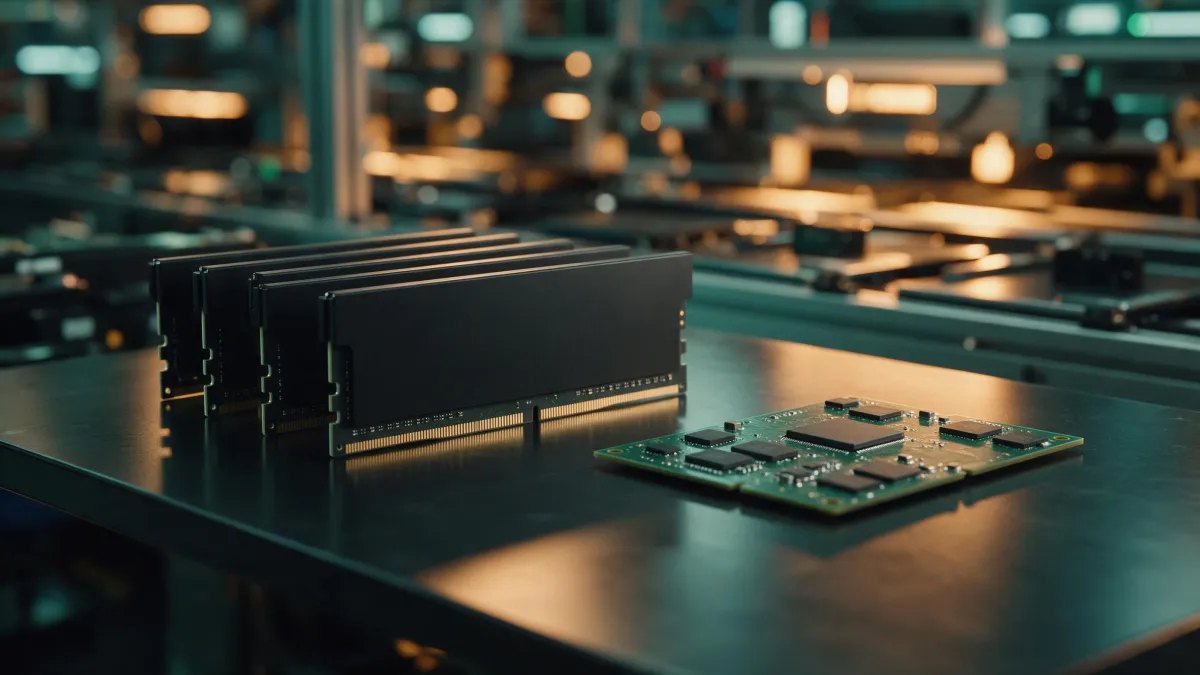
On 11 November 2026, DRAM spot trackers showed DDR5 memory chips trading around 484% higher than a year earlier, days after TrendForce forecast Q4 2026 PC DRAM contract prices would rise another 13%–18%. For every Arab trader importing electronics from China, this matters: the AI build-out is absorbing the world's memory capacity and pushing component costs to multi-year highs. Here is what is happening, with documented figures, and what to do about it.
Why are memory chip prices rising in November 2026?
The direct answer: the AI boom has reallocated global memory capacity toward HBM, shrinking supply of conventional DRAM. Producing one bit of HBM — the stacked memory feeding AI accelerators — consumes roughly three times the wafer capacity of a standard DDR5 bit, so every gain in HBM output comes out of mainstream memory supply.
Samsung, SK hynix and Micron have effectively sold out their DRAM and HBM output through the end of 2027, leaving many buyers on allocation with 60% to 70% of requested volumes (Z2 Data, August 2026). SEMI China estimates the HBM market at about $54.6 billion in 2026, up 58% — nearly 40% of DRAM revenue — with a 50%–60% supply gap. The result is a structural repricing: global DRAM revenue reached roughly $200 billion in Q3 2026, up 369% year-on-year, driven mainly by prices rather than volumes, per Counterpoint Research (5 November 2026). The Chinese factories assembling your devices are paying far more for the same component.
Which numbers should you know before placing a new electronics order?
The short answer: watch four indicators — DRAM contract prices, DDR5 lead times, NAND spot prices and circuit-board material costs — they determine the quotation a Chinese factory will send you. Key documented figures as of 11 November 2026:
| Indicator | Value | Period / Date | Source |
|---|---|---|---|
| PC DRAM contract prices | Forecast +13% to +18% QoQ | Q4 2026 | TrendForce (30 October 2026) |
| DDR5 spot price (16Gb chip) | $61.35, up 484% year-on-year | 11 November 2026 | DRAMeXchange-based market tracker |
| DDR4 contract price (8Gb chip) | $27.5 average, +5.77% MoM | October 2026 | DRAMeXchange via 21st Century Business Herald |
| DDR5 lead time | 17 weeks to 50 weeks (+733% vs normal) | March to August 2026 | Z2 Data |
| Buyer allocation at major makers | 60% to 70% of requested volumes | 2026 | Z2 Data |
| HBM market size | $54.6 billion (+58% YoY) | Full year 2026 | SEMI China via Shanghai Securities News |
| Global DRAM revenue | About $200 billion, +369% YoY | Q3 2026 | Counterpoint Research |
| China's electromechanical-product imports | 8.17 trillion yuan (+35%) | January–October 2026 | General Administration of Customs of China |
Note the last row: China imported 8.17 trillion yuan of electromechanical products — the category that includes electronics and their components — in January–October 2026, up 35%, and exported 16.81 trillion yuan worth, up 25.2%. Chinese factories compete for scarce, costly components, and that cost passes into their quotations.
How do chip costs flow into phone, PC and server prices?
The direct answer: through component contracts over one to two quarters, and the pass-through is already visible. A single 64GB DDR5 server module (RDIMM) traded near $2,064 on spot markets in November 2026, up about 455% year-on-year — memory alone reshapes any server's bill of materials. In retail, a 32GB DDR5-6000 kit sold for $429–$450 in mid-October 2026; Gartner projects combined DRAM and SSD prices up 130% by end-2026, lifting PC prices roughly 17%.
Graphics products are not immune: GDDR6 spot prices are up close to 195% year-on-year. Notebook makers are retreating: laptop shipments fell 14% quarter-on-quarter in Q3 2026 and are forecast to fall another 9% in Q4 2026, and while suppliers asked for 15%–20% increases in Q4 talks, most deals closed at 10% to 15% (TrendForce, 30 October 2026).
But the picture is not uniform. NAND flash — the storage memory in phones and SSDs — is behaving differently: MLC NAND contract prices stayed flat at $30.61 in October 2026, and consumer SSD and eMMC channel prices softened in early November 2026 (DRAMeXchange data). Older DDR4 keeps rising but more slowly than DDR5. Not everything electronic is getting more expensive at the same speed; knowing which memory sits inside your product is a negotiating skill. Smart-home devices feel the squeeze more gradually, through logic and power components whose lead times have stretched to 26–28 weeks (Z2 Data).
What does this mean for Gulf importers specifically?
Three practical effects: higher quotations for specific categories, longer delivery times, and tougher factory terms on payments and quantities. In shortage cycles, factories prioritize large customers on long contracts, quotes expire in days instead of weeks, and some suppliers demand larger deposits to lock components before the next increase.
Many buyers miss an indirect effect: the printed circuit board itself. Record copper prices, shortages of specialty fiberglass and disrupted PPE resin supply are squeezing CCL — the laminate every PCB is built on (Z2 Data). Passive components saw repeated pricing rounds: Yageo raised capacitor prices by roughly 50% from 1 July 2026, Samsung Electro-Mechanics raised all MLCC shipment prices by 30% from 1 August 2026, and TrendForce expects a further 25%–30% increase on consumer-grade parts in Q4 2026. These components go into virtually every device.
From the experience of Keerki Limited's team in Guangzhou, what separates traders in such cycles is reading the bill of materials: knowing which part of a price increase is justified — and which part is inflation contagion.
Practical steps: how should you act over the next two quarters?
Six ordered steps, from your own inventory to shipping booked before the seasonal rush:
- Segment your stock and orders by component exposure: DRAM-dependent (PCs, servers, graphics cards), NAND-dependent (storage, budget devices), or memory-free (accessories, cables) — each needs a different strategy.
- Ask every factory for a detailed bill of materials (BOM): which chip, from which supplier, at what capacity — the foundation of any real negotiation.
- Secure Q1–Q2 2027 pricing early: Q4 2026 contract negotiations closed in November 2026 at increases of 10%–15%, so a committed-volume contract signed in November–December 2026 is very likely cheaper than spot buying in Q1 2027.
- Widen your supplier base: add one or two qualified alternatives per sensitive line, starting with the factories recommended by Keerki or the Canton Fair supplier directory of 35,000+ suppliers.
- Review memory specifications before committing: for mid-range devices, a slightly lower spec is often adequate for Gulf markets and saves real money during an upcycle.
- Schedule production and shipping early: with the year-end peak and the Chinese New Year in February 2027, orders will squeeze factory capacity and freight space — booking production in November–December 2026 beats the congestion.
A tip from Keerki: shortage seasons breed price-increase contagion: some suppliers raise prices "because of the memory crisis" even on products containing no DRAM — cables, basic chargers, accessories. Always request the bill of materials. If your product relies mainly on NAND storage, remember consumer SSD and eMMC channel prices softened in early November 2026 while DRAM set records — a strong negotiating card. Our team in Guangzhou checks actual component prices and matches them against supplier quotations before you commit.
When will prices calm down, and what should you watch through mid-2027?
The direct answer: do not expect real relief before 2027; most documented estimates point to tightness through at least the first half of 2027. TrendForce expects the shortage of high-end MLCCs to be most severe in the first half of 2027 as new AI platforms ramp, Counterpoint notes that major new wafer fabs will not start production before 2028, and one Korean press projection puts 2027 HBM4 contract prices at up to 121% above 2026 levels — roughly double — if the supply gap persists.
Track three indicators: TrendForce's quarterly DRAM contract prices; capacity expansion at the big three producers; and board laminate and passive-component pricing — the early cost indicator for any device. If home appliances are your business, see our guide on importing home appliances from China and SASO requirements.
Frequently Asked Questions
Will electronics imported from China get more expensive in 2026?
Yes, but selectively. Products built around DRAM — PCs, servers, graphics cards — face strong pressure, while consumer NAND storage markets were stable and even softened in early November 2026. The answer depends on which memory sits inside your product.
What is the difference between DDR5 and HBM, and why should an importer care?
DDR5 is the fast working memory inside the computers and servers you import; HBM is stacked memory for AI accelerators. One bit of HBM consumes roughly three times the wafer capacity of a DDR5 bit — so the more HBM the industry makes, the scarcer and pricier the DDR5 in your devices. That is exactly what drives the November 2026 crunch.
Is it better to buy during a price upcycle or wait for prices to fall?
If you genuinely need stock within the next two quarters, waiting is not wise in this cycle: contract prices are rising (13%–18% forecast for PC DRAM in Q4 2026) and lead times are stretching. Secure volumes at contracted prices early, and avoid over-stocking products whose specifications age quickly.
Does the memory crunch affect smartphones too?
Yes, though more moderately. Phones use NAND storage and LPDDR working memory; TrendForce reports mobile DRAM prices still rising in Q4 2026 but more slowly, and smartphone makers trimming production as memory costs climb. Flagship models are the most exposed.
How much could this add to the cost of a container of electronics?
No single number fits all — it depends on your mix. Reference points from November 2026: a 64GB DDR5 server memory module trades near $2,064 on spot markets, a 32GB DDR5 retail kit near $450, and capacitors and board laminates have gone through repeated price rounds since July 2026. A container of computing devices is hit several times harder than one of cables and accessories.
Conclusion
The memory market in November 2026 is in an exceptional AI-driven upcycle: PC DRAM contract prices are rising 13%–18% in Q4, DDR5 lead times approached a full year by August 2026, and the pressure extends from servers down to circuit boards and capacitors. Yet opportunities remain for those who read the map: NAND-based categories are relatively stable, early price locking protects margins, and understanding the bill of materials turns negotiation from an argument about price into a discussion about facts.
Keerki Limited is a China-based sourcing and commercial representation company headquartered in Guangzhou, helping businesses in the Gulf and the Arab world import from China safely for over 10 years. In a price cycle like this one, our value sits in the daily details: verifying bills of materials, negotiating with factories based on actual market prices, inspecting quality before shipment, and consolidating cargo to reduce cost and risk. If you are planning an electronics shipment for the first half of 2027, reach us through the request form on our website or directly on WhatsApp: +86 133 9212 7362.